An Essay on the Principle of Population
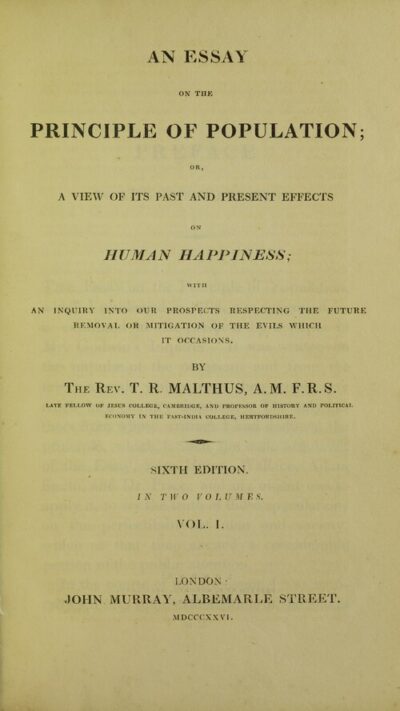
An Essay on the Principle of Population is a 1798 treatise by Thomas Malthus. It was written by Thomas Robert Malthus.
- Published
- 1798
- Written by
- Thomas Robert Malthus
- Genre
- essay
- Country of origin
- England
All 6 facts, and where they come from
Facts
6 facts · 0 confirmed by two sources · 0 cited · 6 from one source
Where this comes from
Papalocal keeps its own record. It started from these sources; what each one said is kept here as it was copied, so a change on their side never changes this page by itself. Tap one to read its version.
What Wikidata says · copied November 17, 2026 · revision 2570442484
- Described as
- 1798 treatise by Thomas Malthus
- Other names
- Principle of Population
- What it is
- literary work
- Written by
- Thomas Robert Malthus
- Genre
- essay
- Published
- 1798
- Language
- English
- Country of origin
- England · 1 reference
- Wikipedias with a page
- 27
Wikidata item Q851988 (wikidata.org/wiki/Q851988), public domain (CC0). Copied 2026-11-17.
What Wikipedia says · copied November 17, 2026 · revision 1384254876
The book An Essay on the Principle of Population was first published anonymously in 1798, but the author was soon identified as Thomas Robert Malthus. The book warned of future difficulties, on an interpretation of the population increasing in geometric progression (so as to double every 25 years) while food production increased in an arithmetic progression, which would leave a difference resulting in the want of food and famine, unless birth rates decreased.
While it was not the first book on population, Malthus's book fuelled debate about the size of the population in Britain and contributed to the passing of the Census Act 1800. This Act enabled the holding of a national census in England, Wales and Scotland, starting in 1801 and continuing every ten years to the present. The book's 6th edition (1826) was independently cited as a key influence by both Charles Darwin and Alfred Russel Wallace in developing the theory of natural selection.
A key portion of the book was dedicated to what is now known as the Malthusian Law of Population. The theory claims that growing population rates contribute to a rising supply of labour and inevitably lowers wages. In essence, Malthus feared that continued population growth lends itself to poverty.
In 1803, Malthus published, under the same title, a heavily revised second edition of his work. His final version, the 6th edition, was published in 1826. In 1830, 32 years after the first edition, Malthus published a condensed version entitled A Summary View on the Principle of Population, which included responses to criticisms of the larger work.
From the Wikipedia article “An Essay on the Principle of Population” (en.wikipedia.org/wiki/An_Essay_on_the_Principle_of_Population), by its contributors, under CC BY-SA 4.0 (creativecommons.org/licenses/by-sa/4.0/). Copied 2026-11-17; not changed.
Confirmed Two sources agree. Cited One source, and it names where it got it. One source One source, without a reference of its own. Sources disagree The sources disagree. We show the best-supported value and keep theirs below.
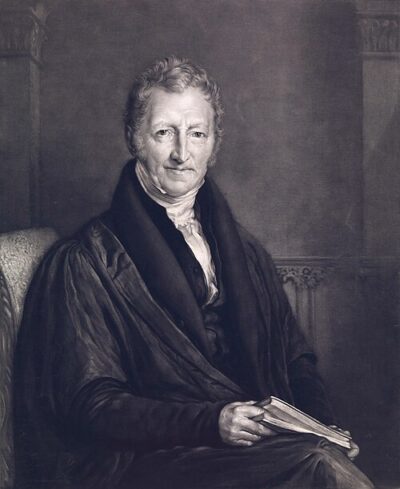
Picture: Malthus, Thomas Robert, via Wikimedia Commons · Public domain