
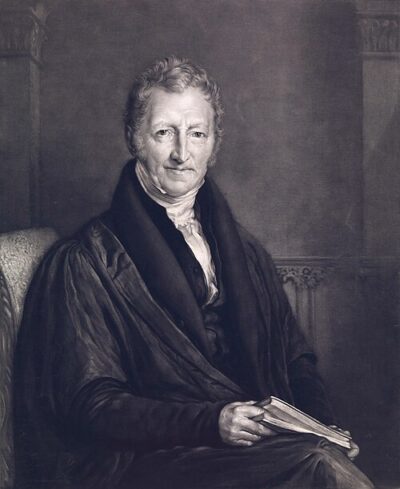
Thomas Robert Malthus
Thomas Robert Malthus was a British political economist. Born February 14, 1766, in Westcott. Died December 29, 1834, in Bath. Known for Malthusian growth model, Malthusianism and An Essay on the Principle of Population. Educated at Jesus College and University of Cambridge. Awards include Fellow of the Royal Society.
Facts
35 facts · 2 confirmed by two sources · 13 cited · 20 from one source
What’s different
- Born: we show February 14, 1766 (Confirmed). Wikidata also lists February 13, 1766
- Died: we show December 29, 1834 (Confirmed). Wikidata also lists December 23, 1834
Where this comes from
Papalocal keeps its own record. It started from these sources; what each one said is kept here as it was copied, so a change on their side never changes this page by itself. Tap one to read its version.
What Wikidata says · copied November 16, 2026 · revision 2568299515
- Described as
- British political economist (1766–1834)
- Other names
- Thomas Malthus, Thomas R. Malthus
- Born
- February 13, 1766 · 2 references; February 14, 1766 · 1 reference
- Died
- December 23, 1834 · 4 references; December 29, 1834 · 2 references
- Born in
- Westcott
- Died in
- Bath · 5 references
- Buried in
- Bath Abbey · 1 reference
- Name at birth
- Thomas Robert Malthus
- Citizen of
- United Kingdom of Great Britain and Ireland; Kingdom of Great Britain (–1801)
- Occupation
- economist; essayist; statistician; demographer · 1 reference; Anglican priest; sociologist; mathematician · 1 reference; writer · 1 reference
- Education
- Jesus College (1784–); University of Cambridge; Warrington Academy
- Member of
- Royal Society of London (1818–); Russian Academy of Sciences
- Known for
- Malthusian growth model; Malthusianism; An Essay on the Principle of Population; Malthusian catastrophe
- Awards
- Fellow of the Royal Society
- Spouse
- Harriet Eckersall · 1 reference
- Children
- Henry Malthus · 2 references; Lucy Malthus · 2 references; Emily Malthus · 2 references
- Father
- Daniel Malthus · 1 reference
- Mother
- Catherine Graham · 1 reference
- Siblings
- Mary Anne Malthus · 1 reference; Sydenham Malthus · 1 reference
- Religion
- Anglicanism
- Wikipedias with a page
- 106
Wikidata item Q13526 (wikidata.org/wiki/Q13526), public domain (CC0). Copied November 16, 2026.
What Wikipedia says · copied November 16, 2026 · revision 1384645247
Thomas Robert Malthus (; 13/14 February 1766 – 29 December 1834) was an English economist, Christian priest, and scholar influential in the fields of political economy and demography.
In his 1798 book An Essay on the Principle of Population, Malthus observed that an increase in a nation's food production improved the well-being of the population, but the improvement was temporary because it led to population growth, which in turn restored the original per capita production level. In other words, humans had a propensity to use abundance for population growth rather than for maintaining a high standard of living, a view and stance that has become known as the "Malthusian trap" or the "Malthusian spectre." Populations had a tendency to grow until the lower class suffered hardship, want, and greater susceptibility to war, famine, and disease, a pessimistic view that is sometimes referred to as a Malthusian catastrophe. Malthus wrote in opposition to the popular view in 18th-century Europe that saw society as improving and in principle as perfectible.
Malthus considered population growth as inevitable whenever conditions improved thereby precluding real progress towards a utopian society: "The power of population is indefinitely greater than the power in the earth to produce subsistence for man." As an Anglican cleric, he saw this situation as divinely imposed to teach virtuous behavior. Malthus wrote that "the increase of population is necessarily limited by subsistence," "population does invariably increase when the means of subsistence increase," and "the superior power of population repress by moral restraint, vice, and misery."
Malthus criticised the Poor Laws for leading to inflation rather than improving the well-being of the poor. He supported taxes on grain imports (the Corn Laws). His views became influential and controversial across economic, political, social, and scientific thought. Pioneers of evolutionary biology read him, notably Charles Darwin and Alfred Russel Wallace. U.S. Founding Fathers and Presidents Thomas Jefferson and James Madison read Malthus. Malthus's failure to predict the Industrial Revolution was a frequent criticism of his theories. Malthus laid the "theoretical foundation of the conventional wisdom that has dominated the debate, both scientifically and ideologically, on global hunger and famines for almost two centuries."
- Born, in its opening lines
- February 14, 1766
- Died, in its opening lines
- December 29, 1834
From the Wikipedia article “Thomas Robert Malthus” (en.wikipedia.org/wiki/Thomas_Robert_Malthus), by its contributors, under CC BY-SA 4.0 (creativecommons.org/licenses/by-sa/4.0/). Copied November 16, 2026; not changed.
Confirmed Two sources agree. Cited One source, and it names where it got it. One source One source, without a reference of its own. Sources disagree The sources disagree. We show the best-supported value and keep theirs below.
