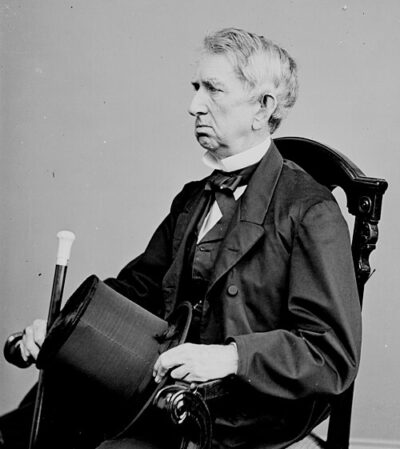
Anti-Masonic Party
The Anti-Masonic Party is an American political party opposed to the Freemasons. It was founded in 1828 by William Wirt and Solomon Southwick. Its headquarters are in Washington, D.C. It stands for anti-Masonry, economic nationalism and social conservatism.
- Country
- United States
- Founded
- 1828
- Ideology
- anti-Masonry
All 11 facts, and where they come from
Facts
11 facts · 0 confirmed by two sources · 0 cited · 11 from one source
Where this comes from
Papalocal keeps its own record. It started from these sources; what each one said is kept here as it was copied, so a change on their side never changes this page by itself. Tap one to read its version.
What Wikidata says · copied November 16, 2026 · revision 2556003846
- Described as
- American political party opposed to the Freemasons
- Other names
- Anti-Masonic Movement
- What it is
- defunct political party
- Followed by
- Whig Party
- Founded
- 1828
- Ended
- 1838
- Founded by
- William Wirt; Solomon Southwick
- Headquarters
- Washington, D.C.
- Country
- United States · 1 reference
- Ideology
- anti-Masonry; economic nationalism · 1 reference; social conservatism · 1 reference
- Wikipedias with a page
- 24
Wikidata item Q574701 (wikidata.org/wiki/Q574701), public domain (CC0). Copied 2026-11-16.
What Wikipedia says · copied November 16, 2026 · revision 1381673383
The Anti-Masonic Party was the earliest third party in the United States. Formally a single-issue party, it strongly opposed Freemasonry in the United States. It was active from the late 1820s, especially in the Northeastern United States, and later attempted to become a major party by expanding its platform to take positions on other issues. It declined quickly after 1832 as most members joined the new Whig Party; it dissolved after 1838.
The party was founded following the disappearance of William Morgan, a former Mason who had become a prominent critic of the Masonic organization. Many believed that Masons had murdered Morgan for speaking out against Masonry and subsequently many churches and other groups condemned Masonry. As many Masons were prominent businessmen and politicians, the backlash against the Masons was also a form of anti-elitism. The Anti-Masons purported that Masons posed a threat to American republicanism by secretly trying to control the government. Furthermore, there was a strong fear that Masonry was hostile to Christianity.
Mass opposition to Masonry eventually coalesced into a political party. Before and during the presidency of John Quincy Adams, there was a period of political realignment. The Anti-Masons emerged as a third-party alternative to Andrew Jackson's Democrats and Adams' National Republicans. In New York, the Anti-Masons supplanted the National Republicans as the primary opposition to the Democrats.
After experiencing unexpected success in the 1828 elections, the Anti-Masons adopted positions on other issues, including support for internal improvements and a protective tariff. Several Anti-Masons, including William A. Palmer and Joseph Ritner, won election to prominent positions. In states such as Pennsylvania and Rhode Island, the party controlled the balance of power in the state legislature and provided crucial support to candidates for the United States Senate. In 1831, the party held the first presidential nominating convention, a practice that was subsequently adopted by all major parties. Delegates chose former U.S. attorney general William Wirt as their standard bearer in the 1832 presidential election; Wirt won 7.8% of the popular vote and carried Vermont.
As the 1830s progressed, many of the Anti-Masonic Party's supporters joined the Whig Party, which sought to unite those opposed to the policies of President Jackson. The Anti-Masons brought with them an intense distrust of politicians and a rejection of unthinking party loyalty, together with new campaign techniques to whip up excitement among the voters. The Anti-Masonic Party held a national convention in 1835, nominating Whig candidate William Henry Harrison, but a second convention announced that the party would not officially support a candidate. Harrison campaigned as a Whig in the 1836 presidential election and his relative success in the election encouraged further migration of Anti-Masons to the Whig Party. By 1840, the party had ceased to function as a national organization. In subsequent decades, former Anti-Masonic candidates and supporters such as Millard Fillmore, William H. Seward, Thurlow Weed and Thaddeus Stevens became prominent members of the Whig Party.
From the Wikipedia article “Anti-Masonic Party” (en.wikipedia.org/wiki/Anti-Masonic_Party), by its contributors, under CC BY-SA 4.0 (creativecommons.org/licenses/by-sa/4.0/). Copied 2026-11-16; not changed.
Confirmed Two sources agree. Cited One source, and it names where it got it. One source One source, without a reference of its own. Sources disagree The sources disagree. We show the best-supported value and keep theirs below.