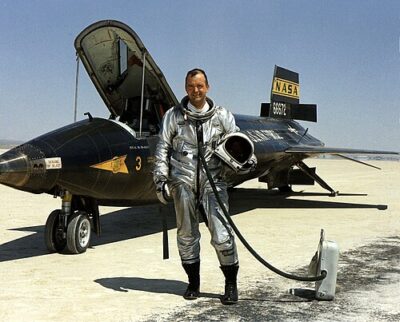
Armstrong Flight Research Center
Armstrong Flight Research Center is a NASA aerospace research center in California, USA. It was founded in 1946. Its headquarters are in Edwards Air Force Base.
- Founded
- September 30, 1946
- Headquarters
- Edwards Air Force Base
- Country
- United States
All 11 facts, and where they come from
Facts
11 facts · 0 confirmed by two sources · 3 cited · 8 from one source
Where this comes from
Papalocal keeps its own record. It started from these sources; what each one said is kept here as it was copied, so a change on their side never changes this page by itself. Tap one to read its version.
What Wikidata says · copied November 19, 2026 · revision 2555345321
- Described as
- NASA aerospace research center in California, USA
- Other names
- Hugh L. Dryden Flight Research Center, Dryden Flight Research Center, NASA Dryden Flight Research Center, DFRC, Neil A. Armstrong Flight Research Center, NASA Armstrong Flight Research Center, AFRC, Muroc Flight Test Unit, NACA High-Speed Flight Research Station, High-Speed Flight Research Station, NACA High-Speed Flight Station, NASA High-Speed Flight Station
- What it is
- NASA facility; research institute; research center
- Founded
- September 30, 1946 · 1 reference
- Headquarters
- Edwards Air Force Base
- Located in
- Kern County
- Country
- United States
- Part of
- National Aeronautics and Space Administration · 1 reference
- Named after
- Hugh Latimer Dryden (1976–2014) · 1 reference; Neil Armstrong (2014–) · 2 references
- Official website
- https://www.nasa.gov/armstrong/
- Wikipedias with a page
- 19
Wikidata item Q305443 (wikidata.org/wiki/Q305443), public domain (CC0). Copied 2026-11-19.
What Wikipedia says · copied November 19, 2026 · revision 1382672146
The NASA Neil A. Armstrong Flight Research Center (AFRC) is an aeronautical research center operated by NASA. Its primary campus is located inside Edwards Air Force Base in California and is considered NASA's premier site for aeronautical research. AFRC operates some of the most advanced aircraft in the world and is known for many aviation firsts, including supporting the first crewed airplane to exceed the speed of sound in level flight (Bell X-1), highest speed by a crewed, powered aircraft (North American X-15), the first pure digital fly-by-wire aircraft (F-8 DFBW), and many others. AFRC operated a second site next to Air Force Plant 42 in Palmdale, California, known as Building 703, once the former Rockwell International/North American Aviation production facility. There, AFRC housed and operated several of NASA's Science Mission Directorate aircraft including the Stratospheric Observatory for Infrared Astronomy (SOFIA), a DC-8 Flying Laboratory, a Gulfstream C-20A UAVSAR and ER-2 High Altitude Platform. In 2024, following the retirements of SOFIA and the DC-8, NASA vacated Building 703, as the continued lease of the large hangar was no longer justified or a prudent use of taxpayer dollars. As of 2023, Bradley Flick is the center's director.
Established as the National Advisory Committee for Aeronautics Muroc Flight Test Unit (1946), the center was subsequently known as the NACA High-Speed Flight Research Station (1949), the NACA High-Speed Flight Station (1954), the NASA High-Speed Flight Station (1958) and the NASA Flight Research Center (1959). On 26 March 1976, the center was renamed the NASA Ames-Dryden Flight Research Center (DFRC) after Hugh L. Dryden, a prominent aeronautical engineer who died in office as NASA's deputy administrator in 1965 and Joseph Sweetman Ames, who was an eminent physicist, and served as president of Johns Hopkins University. The facility took its current name on 1 March 2014, honoring Neil Armstrong, a former test pilot at the center and the first human being to walk on the Moon.
AFRC was the home of the Shuttle Carrier Aircraft (SCA), a modified Boeing 747 designed to carry a Space Shuttle orbiter back to Kennedy Space Center if one landed at Edwards.
The center long operated the oldest B-52 Stratofortress bomber, a B-52B (dubbed Balls 8 after its tail number, 008) that had been converted to a drop test aircraft. 008 dropped many supersonic test vehicles, from the X-15 to its last research program, the hypersonic X-43A, powered by a Pegasus rocket. Retired in 2004, the aircraft is on display near Edwards' North Gate.
From the Wikipedia article “Armstrong Flight Research Center” (en.wikipedia.org/wiki/Armstrong_Flight_Research_Center), by its contributors, under CC BY-SA 4.0 (creativecommons.org/licenses/by-sa/4.0/). Copied 2026-11-19; not changed.
Confirmed Two sources agree. Cited One source, and it names where it got it. One source One source, without a reference of its own. Sources disagree The sources disagree. We show the best-supported value and keep theirs below.
Picture: Wikimedia Commons: Edw-081013-03-dryden-12.jpg · See Commons file page