ARPANET
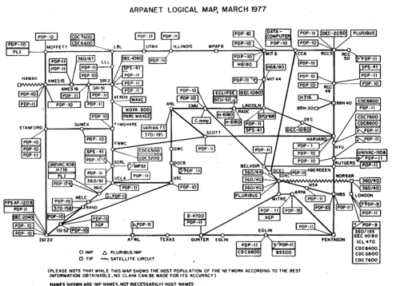
ARPANET is an early packet switching network (1969–1990). It was made by the Massachusetts Institute of Technology. It is based on ARPANET Reference Model.
All 7 facts, and where they come from
Facts
7 facts · 0 confirmed by two sources · 1 cited · 6 from one source
Where this comes from
Papalocal keeps its own record. It started from these sources; what each one said is kept here as it was copied, so a change on their side never changes this page by itself. Tap one to read its version.
What Wikidata says · copied November 17, 2026 · revision 2547546308
- Described as
- early packet switching network (1969–1990)
- Other names
- Advanced Research Projects Agency Network, ARPAnet, Aparnet
- What it is
- computer network · 1 reference; decentralized computing; communication protocol
- Made by
- Massachusetts Institute of Technology
- Based on
- ARPANET Reference Model
- Named after
- Defense Advanced Research Projects Agency; computer network
- Wikipedias with a page
- 66
Wikidata item Q177524 (wikidata.org/wiki/Q177524), public domain (CC0). Copied 2026-11-17.
What Wikipedia says · copied November 17, 2026 · revision 1383418506
The Advanced Research Projects Agency Network (ARPANET) was the first wide-area packet-switched network with distributed control and one of the first computer networks to implement the TCP/IP protocol suite. Both technologies became the technical foundation of the Internet. The ARPANET was established by the Advanced Research Projects Agency (now DARPA) of the United States Department of Defense.
Building on the ideas of J. C. R. Licklider, Bob Taylor initiated the ARPANET project in 1966 to enable resource sharing between remote computers. Taylor appointed Larry Roberts as program manager. Roberts made the key decisions about the request for proposal to build the network. He incorporated Donald Davies' concepts and designs for packet switching, and sought input from Paul Baran. In 1969, ARPA awarded the contract to build the Interface Message Processors (IMPs) for the network to Bolt Beranek & Newman (BBN). The design was led by Bob Kahn who developed the first protocol for the network. Roberts engaged Leonard Kleinrock at UCLA to develop mathematical methods for analyzing the packet network technology.
The first computers were connected in 1969 and the Network Control Program was implemented in 1970, development of which was led by Steve Crocker at UCLA and other graduate students, including Jon Postel. The network was declared operational in 1971. Further software development enabled remote login and file transfer, which was used to provide an early form of email. The network expanded rapidly and operational control passed to the Defense Communications Agency in 1975.
Bob Kahn moved to DARPA and, together with Vint Cerf at Stanford University, formulated the Transmission Control Program for internetworking. As this work progressed, a protocol was developed by which multiple separate networks could be joined into a network of networks; this incorporated concepts pioneered in the French CYCLADES project directed by Louis Pouzin and the ideas of Bob Metcalfe at Xerox Parc. Version 4 of TCP/IP was installed in the ARPANET for production use on 1 January 1983, after the Department of Defense made it standard for all military computer networking.
Access to the ARPANET was expanded in 1981 when the National Science Foundation (NSF) funded the Computer Science Network (CSNET). In the early 1980s, the NSF funded the establishment of national supercomputing centers at several universities and provided network access and network interconnectivity with the NSFNET project in 1986. The ARPANET was formally decommissioned in 1990, after partnerships with the telecommunication and computer industry had assured private sector expansion and commercialization of an expanded worldwide network, known as the Internet.
From the Wikipedia article “ARPANET” (en.wikipedia.org/wiki/ARPANET), by its contributors, under CC BY-SA 4.0 (creativecommons.org/licenses/by-sa/4.0/). Copied 2026-11-17; not changed.
Confirmed Two sources agree. Cited One source, and it names where it got it. One source One source, without a reference of its own. Sources disagree The sources disagree. We show the best-supported value and keep theirs below.
Picture: ARPANET, via Wikimedia Commons · Public domain