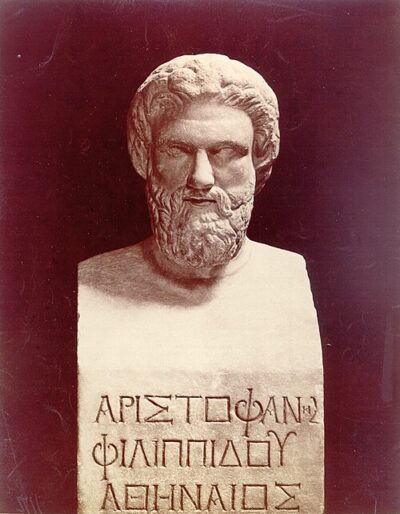
Assemblywomen
Assemblywomen is a comedy by Aristophanes.
- Written by
- Aristophanes
- Genre
- Old Comedy
All 4 facts, and where they come from
Facts
4 facts · 0 confirmed by two sources · 2 cited · 2 from one source
Where this comes from
Papalocal keeps its own record. It started from these sources; what each one said is kept here as it was copied, so a change on their side never changes this page by itself. Tap one to read its version.
What Wikidata says · copied November 17, 2026 · revision 2514312920
- Described as
- comedy by Aristophanes
- Other names
- Ecclesiazusae, Women in Council, The Ecclesiazusæ, The Female Haranguers, Aristoph. Eccl.
- What it is
- dramatic work
- Written by
- Aristophanes · 1 reference
- Genre
- Old Comedy
- Language
- Ancient Greek · 1 reference
- Wikipedias with a page
- 31
Wikidata item Q608261 (wikidata.org/wiki/Q608261), public domain (CC0). Copied 2026-11-17.
What Wikipedia says · copied November 17, 2026 · revision 1379564997
Assemblywomen (Ancient Greek: Ἐκκλησιάζουσαι Ekklesiazousai; also translated as, Congresswomen, Women in Parliament, Women in Power, A Parliament of Women, Assembly-Women, and Women in the Assembly) is a comedy written by the Greek playwright Aristophanes in 391 BCE. The play portrays a scenario where the women of Athens assume control of the government and institute totalitarian proto-communist reforms that ban private wealth and enforce sexual equity for the old and unattractive. In addition to Aristophanes' political and social satire, Assemblywomen derives its comedy through sexual and scatological humor. The play aimed to criticize the Athenian government's expropriation of land and wealth at the time.
From the Wikipedia article “Assemblywomen” (en.wikipedia.org/wiki/Assemblywomen), by its contributors, under CC BY-SA 4.0 (creativecommons.org/licenses/by-sa/4.0/). Copied 2026-11-17; not changed.
Confirmed Two sources agree. Cited One source, and it names where it got it. One source One source, without a reference of its own. Sources disagree The sources disagree. We show the best-supported value and keep theirs below.