
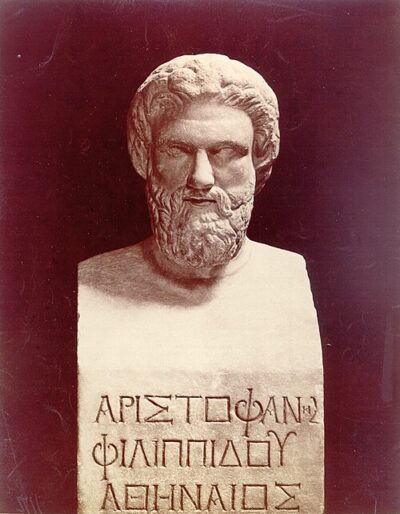
Aristophanes
Aristophanes was a Classical Athenian comic playwright (c. 446 – c. 386 BC). Born 445 BC, in Classical Athens. Died 385 BC, in Classical Athens. Known for The Acharnians, The Birds and The Clouds.
Facts
24 facts · 0 confirmed by two sources · 8 cited · 16 from one source
Where this comes from
Papalocal keeps its own record. It started from these sources; what each one said is kept here as it was copied, so a change on their side never changes this page by itself. Tap one to read its version.
What Wikidata says · copied November 16, 2026 · revision 2568730483
- Described as
- Classical Athenian comic playwright (c. 446 – c. 386 BC)
- Other names
- Father of Comedy
- Born
- 445 BC · 3 references
- Died
- 385 BC · 7 references
- Born in
- Classical Athens · 2 references
- Died in
- Classical Athens · 3 references
- Citizen of
- Classical Athens
- Occupation
- comedy writer · 2 references; playwright · 3 references; poet · 2 references; writer · 1 reference
- Genre
- comedy
- Known for
- The Acharnians; The Birds; The Clouds; Assemblywomen; The Frogs; The Knights; Lysistrata; Peace; Plutus; Thesmophoriazusae
- Field
- literature · 1 reference; drama
- Children
- Araros
- Father
- Philippus
- Wikipedias with a page
- 149
Wikidata item Q43353 (wikidata.org/wiki/Q43353), public domain (CC0). Copied November 16, 2026.
What Wikipedia says · copied November 16, 2026 · revision 1385468444
Aristophanes (; Ancient Greek: Ἀριστοφάνης [aristopʰánɛːs]; c. 446 – c. 386 BC) was an Ancient Greek comic playwright from Athens. He wrote forty plays, of which eleven survive virtually complete. The majority of his surviving plays belong to the genre of comic drama known as Old Comedy and are considered its most valuable examples. Aristophanes's plays were performed at the religious festivals of Athens, mostly the City Dionysia and the Lenaia, and several of them won the first prize in their respective competitions.
Also known as "The Father of Comedy" and "the Prince of Ancient Comedy", Aristophanes wrote plays that often dealt with real-life figures, including Euripides and Alcibiades, and contemporary events, such as the Peloponnesian War. He has been said to recreate the life of ancient Athens more convincingly than any other author. His plays are characterized by preposterous premises, explicit language, wordplays, and political satire. His powers of ridicule were feared and acknowledged by influential contemporaries; Plato singled out Aristophanes's play The Clouds as slander that contributed to the trial and subsequent condemning to death of Socrates, although other satirical playwrights had also caricatured the philosopher.
Aristophanes's second play, The Babylonians (now lost), was denounced by Cleon as a slander against the Athenian polis. It is possible that the case was argued in court, but details of the trial are not recorded and Aristophanes caricatured Cleon mercilessly in his subsequent plays, especially The Knights, the first of many plays that he directed himself. "In my opinion," he says through that play's Chorus, "the author-director of comedies has the hardest job of all."
From the Wikipedia article “Aristophanes” (en.wikipedia.org/wiki/Aristophanes), by its contributors, under CC BY-SA 4.0 (creativecommons.org/licenses/by-sa/4.0/). Copied November 16, 2026; not changed.
Confirmed Two sources agree. Cited One source, and it names where it got it. One source One source, without a reference of its own. Sources disagree The sources disagree. We show the best-supported value and keep theirs below.
