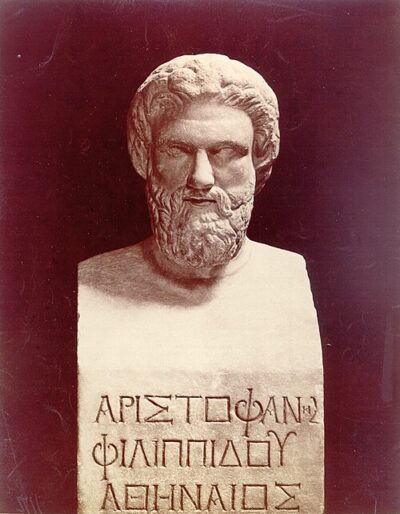
The Frogs
The Frogs is a comedy by Aristophanes.
- Written by
- Aristophanes
- Genre
- Old Comedy
All 4 facts, and where they come from
Facts
4 facts · 0 confirmed by two sources · 2 cited · 2 from one source
Where this comes from
Papalocal keeps its own record. It started from these sources; what each one said is kept here as it was copied, so a change on their side never changes this page by itself. Tap one to read its version.
What Wikidata says · copied November 17, 2026 · revision 2565894702
- Described as
- comedy by Aristophanes
- Other names
- Frogs, Aristoph. Frogs
- What it is
- dramatic work
- Written by
- Aristophanes · 1 reference
- Genre
- Old Comedy
- Language
- Ancient Greek · 1 reference
- Wikipedias with a page
- 39
Wikidata item Q815376 (wikidata.org/wiki/Q815376), public domain (CC0). Copied 2026-11-17.
What Wikipedia says · copied November 17, 2026 · revision 1376310022
The Frogs (Ancient Greek: Βάτραχοι, romanized: Bátrakhoi; Latin: Ranae, often abbreviated Ran. or Ra.) is a comedy written by the Ancient Greek playwright Aristophanes. It was performed at the Lenaia, one of the Festivals of Dionysus in Athens, in 405 BC and received first place.
The play features the comical katabasis of the god of theater Dionysus, with his slave Xanthias, in order to revive the late tragedian Euripides. Dionysus is frustrated with tragedy's decline in quality after the playwright's recent passing, and concerned about theatre's future as the city of Athens struggles in the Peloponnesian War. During the pair's journey through the underworld, the god cravenly and unsuccessfully attempts to evade trouble after masquerading as Heracles, still infamous for his prior kidnapping of the guard-dog Cerberus. At the palace of Pluto, Dionysus then adjudicates a fierce debate between Euripides and Aeschylus for the underworld's throne of tragic drama. Aeschylus wins due to his pragmatism, and Dionysus ends up reviving him instead. The play's title derives from the first choral interlude (parodos), where the chorus, a group of frogs, exasperate Dionysus in song.
A defining work of Old Comedy, The Frogs contains a mix of irreverent humour and highbrow satire of Athenian politics, religion and theatre, commenting on poetry's moral role in civic and political life. The play is notably characterised by its extensive literary criticism and references: the second half's agon between Euripides and Aeschylus examines both figures' differing approaches to tragedy. In 1974, the play was loosely adapted into a musical of the same name by Stephen Sondheim and Burt Shevelove. This adaptation features the Irish playwright George Bernard Shaw and English playwright William Shakespeare, in place of Euripides and Aeschylus respectively.
From the Wikipedia article “The Frogs” (en.wikipedia.org/wiki/The_Frogs), by its contributors, under CC BY-SA 4.0 (creativecommons.org/licenses/by-sa/4.0/). Copied 2026-11-17; not changed.
Confirmed Two sources agree. Cited One source, and it names where it got it. One source One source, without a reference of its own. Sources disagree The sources disagree. We show the best-supported value and keep theirs below.
Picture: Wikimedia Commons: Xanthias Heracles BM VaseF233.jpg · See Commons file page