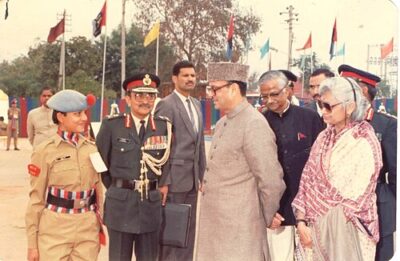
Atomic Energy Commission of India
The Atomic Energy Commission of India is a governing body of India's Department of Atomic Energy. It was founded in 1948. Its headquarters are in Mumbai.
- Founded
- 1948
- Headquarters
- Mumbai
All 4 facts, and where they come from
Facts
4 facts · 0 confirmed by two sources · 0 cited · 4 from one source
Where this comes from
Papalocal keeps its own record. It started from these sources; what each one said is kept here as it was copied, so a change on their side never changes this page by itself. Tap one to read its version.
What Wikidata says · copied November 19, 2026 · revision 2290271668
- Described as
- governing body of India's Department of Atomic Energy
- What it is
- government agency
- Founded
- 1948 · 1 reference
- Headquarters
- Mumbai
- Official website
- http://www.aec.gov.in/
- Wikipedias with a page
- 6
Wikidata item Q3530191 (wikidata.org/wiki/Q3530191), public domain (CC0). Copied 2026-11-19.
What Wikipedia says · copied November 19, 2026 · revision 1368356719
The Atomic Energy Commission of India is the governing body of the Department of Atomic Energy, Government of India. The DAE is under the direct charge of the Prime Minister.
The Indian Atomic Energy Commission was set up on 3 August 1948 under the late Department of Scientific Research. A resolution passed by the Government of India later replaced the commission by "Atomic Energy Commission of India" on ,1 March 1954 under the Department of Atomic Energy with Homi J. Bhabha as secretary and more financial and executive powers, headquartered in Mumbai, Maharashtra.
The functions of the Atomic Energy Commission are:
(i) to organize research in atomic science in the country
(ii) to train atomic scientists in the country
(iii) to promote nuclear research in commission's own laboratories in India
(iv) to undertake prospecting of atomic minerals in India and to extract such minerals for use on industrial scale.
India achieved a major success in terms of breakthrough in science and technology when the Atomic Energy Commission (AEC) detonated an underground nuclear device at Pokhran in the Thar Desert on 18 May 1974.
It has six research centres in India viz.Bhabha Atomic Research Centre (BARC), Mumbai
Indira Gandhi Centre for Atomic Research (IGCAR), Kalpakkam (Tamil Nadu)
Raja Ramanna Centre for Advanced Technology (RRCAT), Indore
Variable Energy Cyclotron Centre (VECC), Kolkata
Atomic Minerals Directorate for Exploration and Research (AMD), Hyderabad.
Global Centre for Nuclear Energy Partnership (GCNEP), Haryana
It also gives financial assistance to autonomous national institutes doing research in the field and has various other organisations under it.
From the Wikipedia article “Atomic Energy Commission of India” (en.wikipedia.org/wiki/Atomic_Energy_Commission_of_India), by its contributors, under CC BY-SA 4.0 (creativecommons.org/licenses/by-sa/4.0/). Copied 2026-11-19; not changed.
Confirmed Two sources agree. Cited One source, and it names where it got it. One source One source, without a reference of its own. Sources disagree The sources disagree. We show the best-supported value and keep theirs below.