
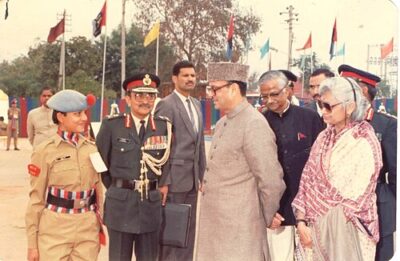
Raja Ramanna
Raja Ramanna was an Indian nuclear scientist. Born January 28, 1925, in Tumkur. Died September 24, 2004, in Mumbai. Positions held include member of Rajya Sabha (1997–2003), chairperson (1975–2004) and director (1981–1984). Educated at King's College London and University of Madras. Awards include Shanti Swarup Bhatnagar Prize for Science and Technology, Padma Shri in Science & Engineering and Padma Vibhushan in Science & Engineering.
Facts
35 facts · 2 confirmed by two sources · 15 cited · 18 from one source
Where this comes from
Papalocal keeps its own record. It started from these sources; what each one said is kept here as it was copied, so a change on their side never changes this page by itself. Tap one to read its version.
What Wikidata says · copied November 18, 2026 · revision 2570485698
- Described as
- Indian nuclear scientist (1925-2004)
- Born
- January 28, 1925 · 2 references
- Died
- September 24, 2004 · 1 reference
- Born in
- Tumkur · 1 reference
- Died in
- Mumbai · 1 reference
- Citizen of
- India (1950–) · 1 reference; British Raj (–1947); Dominion of India (1947–1950)
- Occupation
- physicist; politician · 1 reference; nuclear physicist · 1 reference; engineer; musicologist · 1 reference
- Positions held
- member of Rajya Sabha (1997–2003) · 2 references; chairperson (1975–2004) · 1 reference; director (1981–1984) · 1 reference
- Political party
- Janata Dal
- Worked for
- Bhabha Atomic Research Centre
- Education
- King's College London · 1 reference; University of Madras; Madras Christian College; Bishop Cotton Boys' School
- Member of
- Atomic Energy Commission of India; Indian Academy of Sciences; Indian Institute of Science, Bengaluru; National Institute of Advanced Studies
- Awards
- Shanti Swarup Bhatnagar Prize for Science and Technology (1963) · 1 reference; Padma Shri in Science & Engineering (1968) · 1 reference; Padma Vibhushan in Science & Engineering · 1 reference; Padma Bhushan in Science & Engineering · 1 reference; Om Prakash Bhasin Award (1985)
- Field
- physics · 1 reference; nuclear engineering; nuclear physics
- Religion
- Hinduism · 1 reference
- Lived in
- Mumbai
- Wikipedias with a page
- 21
Wikidata item Q26370 (wikidata.org/wiki/Q26370), public domain (CC0). Copied November 18, 2026.
What Wikipedia says · copied November 18, 2026 · revision 1378229392
Raja Ramanna (28 January 1925 – 24 September 2004) was an Indian nuclear physicist. He was the director of India's nuclear program in the late 1960s and early 1970s, which culminated in Smiling Buddha, India's first successful nuclear weapon test on 18 May 1974.
Ramanna obtained his bachelor's degree in Physics at Madras University and PhD from King's College, London. He joined the Tata Institute of Fundamental Research and later the Bhabha Atomic Research Centre (BARC) to work on nuclear physics. Ramanna worked under Homi Jehangir Bhabha, whom he had met earlier in 1944. He joined the nuclear program in 1964, and later became the director of this program in 1967. Ramanna expanded and supervised scientific research on nuclear weapons and was in charge of the team of scientists at Bhabha Atomic Research Centre (BARC) that designed and carried out the testing of the first nuclear device in 1974. Ramanna was associated with India's nuclear program for more than four decades, and also facilitated research for the Indian Armed Forces.
He served in various roles such as Secretary for Defence Research, Government of India (1978–81), Scientific Adviser to the Minister of Defence (1978–81), Director-general of Defence Research and Development Organisation (1978–82), Chairman of Atomic Energy Commission (1983–87) and Secretary of the Department of Atomic Energy (1983–87). He later became the Minister of state for defence in 1990. He served as a Member of Parliament, Rajya Sabha from 1997 to 2003. Towards the later part of his career, he advocated against nuclear proliferation and testing.
Ramanna was associated with various academic institutions. He was the founder-director of National Institute of Advanced Studies and served as the chairman of board of governors at IIT Bombay. He has been awarded multiple honorary doctorates by various universities. He was awarded the Padma Vibhushan, India's second highest civilian decoration, in 1975. Ramanna died in Mumbai in 2004 at the age of 79.
- Born, in its opening lines
- January 28, 1925
- Died, in its opening lines
- September 24, 2004
From the Wikipedia article “Raja Ramanna” (en.wikipedia.org/wiki/Raja_Ramanna), by its contributors, under CC BY-SA 4.0 (creativecommons.org/licenses/by-sa/4.0/). Copied November 18, 2026; not changed.
Confirmed Two sources agree. Cited One source, and it names where it got it. One source One source, without a reference of its own. Sources disagree The sources disagree. We show the best-supported value and keep theirs below.
