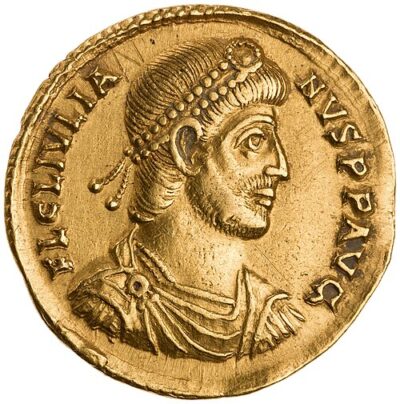
Augustus
Augustus is an imperial rank, honorific and title.
All 3 facts, and where they come from
Facts
3 facts · 0 confirmed by two sources · 0 cited · 3 from one source
Where this comes from
Papalocal keeps its own record. It started from these sources; what each one said is kept here as it was copied, so a change on their side never changes this page by itself. Tap one to read its version.
What Wikidata says · copied November 17, 2026 · revision 2567528143
- Described as
- imperial rank, honorific and title
- Other names
- Avgvstvs
- What it is
- noble title; title of honor; masculine cognomen
- Wikipedias with a page
- 49
Wikidata item Q211804 (wikidata.org/wiki/Q211804), public domain (CC0). Copied 2026-11-17.
What Wikipedia says · copied November 17, 2026 · revision 1368819188
Augustus (plural Augusti; aw-GUST-əs, Classical Latin: [au̯ˈɡʊstʊs]; "majestic", "great", or "venerable") was the main title of the Roman emperors during antiquity. It was given as both a name and a title to Gaius Julius Caesar Octavianus (often referred to simply as Augustus) in 27 BC, marking his accession as Rome's first emperor. On his death, it became an official title of his successor, and was so used by all emperors thereafter.
The feminine form Augusta was used for Roman empresses and other female members of the imperial family. The masculine and feminine forms originated in the time of the Roman Republic, in connection with things considered divine or sacred in traditional Roman religion. Their use as titles for major and minor Roman deities of the Empire associated the imperial system and family with traditional Roman virtues and the divine will and may be considered a feature of the Roman imperial cult.
In Rome's Greek-speaking provinces, "Augustus" was translated as Sebastos (Σεβαστός), or Hellenised as Augoustos (Αὔγουστος); these titles continued to be used in the Byzantine Empire until the Fall of Constantinople in 1453, although they gradually lost their imperial exclusivity in favour of Basileus and Autokrator.
After the fall of the Western Roman Empire, the title "Augustus" would later be incorporated into the style of the Holy Roman Emperor, a precedent set by Charlemagne who used the title serenissimus Augustus. As such, Augustus was sometimes also used as a name for men of aristocratic birth, especially in the lands of the Holy Roman Empire. It remains a given name for males.
From the Wikipedia article “Augustus (title)” (en.wikipedia.org/wiki/Augustus_(title)), by its contributors, under CC BY-SA 4.0 (creativecommons.org/licenses/by-sa/4.0/). Copied 2026-11-17; not changed.
Confirmed Two sources agree. Cited One source, and it names where it got it. One source One source, without a reference of its own. Sources disagree The sources disagree. We show the best-supported value and keep theirs below.