
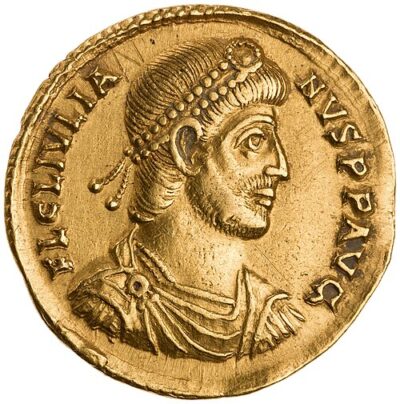
Julian
Julian was a last Pagan Roman emperor, reigned 361 to 363. Born November 17, 331, in Constantinople. Died June 26, 363, in Mesopotamia. Positions held include Roman emperor (360–363), ancient Roman senator and pontifex maximus (360–363). Known for Account of the campaign against the Nardini, Misopogon and Cesars.
Facts
27 facts · 2 confirmed by two sources · 2 cited · 23 from one source
Where this comes from
Papalocal keeps its own record. It started from these sources; what each one said is kept here as it was copied, so a change on their side never changes this page by itself. Tap one to read its version.
What Wikidata says · copied November 16, 2026 · revision 2569124447
- Described as
- last Pagan Roman emperor, reigned 361 to 363
- Other names
- Flavius Claudius Julianus, Julian III, Julian the Apostate, Imperator Caesar Flavius Claudius Julianus Augustus, Julianus II, Flavius Claudius Iulianus, Julian II, Julianus III
- Born
- November 17, 331 · 1 reference
- Died
- June 26, 363 · 1 reference
- Born in
- Constantinople
- Died in
- Mesopotamia
- Buried in
- Tarsus
- Citizen of
- Ancient Rome · 2 references
- Occupation
- politician · 1 reference; philosopher; writer · 1 reference
- Positions held
- Roman emperor (360–363) · 1 reference; ancient Roman senator; pontifex maximus (360–363); Caesar (355–363); Augustus (360–363); tribune of the plebs (360–363); Roman consul (3 times) (356–363)
- Known for
- Account of the campaign against the Nardini; Misopogon; Cesars; Account of the battle of Strasburg
- Spouse
- Helena · 1 reference
- Children
- Flavius
- Father
- Julius Constantius
- Mother
- Basilina
- Siblings
- daughter of Julius Constantius; Constantius Gallus; Julia Galla
- Wikipedias with a page
- 94
Wikidata item Q33941 (wikidata.org/wiki/Q33941), public domain (CC0). Copied November 16, 2026.
What Wikipedia says · copied November 16, 2026 · revision 1385109152
Julian (Latin: Flavius Claudius Julianus; Ancient Greek: Ἰουλιανός Ioulianos; 331 – 26 June 363) was Caesar of the Western Roman Empire from 355 to 360 and Roman emperor from 361 to 363, as well as a notable philosopher and author in Greek. His public conversion from Christianity to paganism and promotion of Neoplatonic form of Hellenism caused him to be remembered as Julian the Apostate in the Christian tradition.
A nephew of Constantine the Great, Julian was one of few in the imperial family to survive the purges and civil wars during the reign of Constantius II, his cousin. Julian was orphaned as a child when his father was executed in 337, and he spent much of his life under Constantius's close supervision. However, the emperor allowed Julian freedom to pursue an education in the Greek-speaking east. In 355, Constantius II appointed Julian to govern Gaul; his rule was successful, defeating and countering Germanic raids across the Rhine and encouraging the provinces' return to prosperity. In 360, he was proclaimed emperor by his soldiers at Lutetia (Paris), sparking a civil war with Constantius. However, Constantius died before the two could face each other in battle, having named Julian as his successor to prevent further bloodshed.
In 363, Julian embarked on an ambitious military expedition against the Sasanian Empire, mustering the largest Roman army to ever face the Persians. The campaign was initially successful, securing a victory outside the capital of Ctesiphon. However, rather than besiege the city, Julian moved into Persia's heartland, where he soon faced supply problems and was forced to retreat northwards while being ceaselessly harassed by Persian skirmishers. During the Battle of Samarra, Julian was mortally wounded. He was succeeded by Jovian, a senior officer in the imperial guard, who was obliged to cede territory, including Nisibis, in order to save the trapped Roman forces. Julian and Jovian were the last sole emperors to rule the whole Empire for their entire reign, after which it was permanently divided between a Western and Eastern court.
Julian was the last non-Christian ruler of the Roman Empire, and he believed it necessary to restore the Empire's ancient Roman values and traditions in order to save it from dissolution. He purged the top-heavy state bureaucracy, openly promoted pagans to high political offices, and attempted to revive traditional Roman religious practices at the expense of Christianity. His efforts to build a Third Temple in Jerusalem were probably intended to harm Christianity rather than please Jews. Julian also expelled Christians from the military and forbade them from teaching and learning classical texts. Though his reign saw a brief resurgence of paganism in public and political life, his policies ultimately had no lasting effect on its continuing decline.
- Born, in its opening lines
- 331
- Died, in its opening lines
- June 26, 363
From the Wikipedia article “Julian (emperor)” (en.wikipedia.org/wiki/Julian_(emperor)), by its contributors, under CC BY-SA 4.0 (creativecommons.org/licenses/by-sa/4.0/). Copied November 16, 2026; not changed.
Confirmed Two sources agree. Cited One source, and it names where it got it. One source One source, without a reference of its own. Sources disagree The sources disagree. We show the best-supported value and keep theirs below.
