Auld Lang Syne
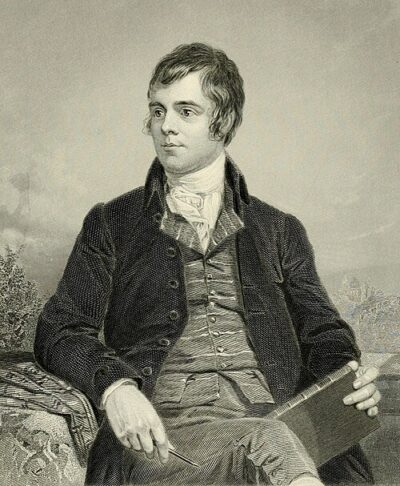
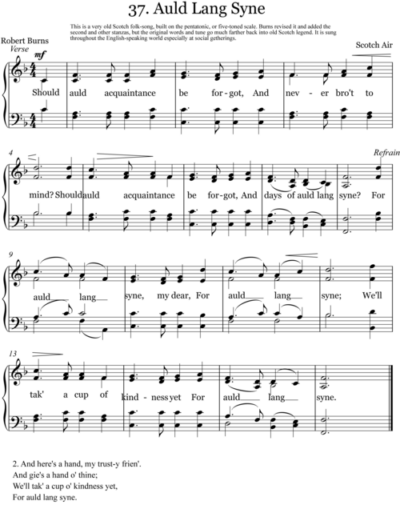
Auld Lang Syne is a Robert Burns poem set to traditional melody. It came out in 1788. It is performed by BBC Symphony Orchestra, Susan Boyle and Sanna Nielsen.
- Released
- 1788
- Performed by
- BBC Symphony Orchestra
- Genre
- traditional folk song
All 8 facts, and where they come from
Facts
8 facts · 0 confirmed by two sources · 0 cited · 8 from one source
Where this comes from
Papalocal keeps its own record. It started from these sources; what each one said is kept here as it was copied, so a change on their side never changes this page by itself. Tap one to read its version.
What Wikidata says · copied November 17, 2026 · revision 2569008473
- Described as
- Robert Burns poem set to traditional melody
- Other names
- Air Sgàth nan Iomadh Linn
- What it is
- musical work/composition
- Performed by
- BBC Symphony Orchestra; Susan Boyle; Sanna Nielsen
- Music by
- traditional
- Genre
- traditional folk song
- Released
- 1788
- Language
- Scots · 1 reference
- Wikipedias with a page
- 55
Wikidata item Q211939 (wikidata.org/wiki/Q211939), public domain (CC0). Copied 2026-11-17.
What Wikipedia says · copied November 17, 2026 · revision 1382591012
"Auld Lang Syne" (Scots: [ˈɔːl(d) lɑŋ ˈsəi̯n]) is a Scottish song. In the English-speaking world it is traditionally sung to bid farewell to the old year at the stroke of midnight on Hogmanay, or New Year's Eve. It is also often heard at funerals and graduations and as a farewell or ending to other occasions; for instance, many branches of the Scouting movement use it to close jamborees and other functions.
The text is a Scots-language poem written by Robert Burns in 1788, but it is based on an older Scottish folk song. In 1799 it was set to a traditional pentatonic tune, which has since become standard. "Auld Lang Syne" is listed as numbers 6294 and 13892 in the Roud Folk Song Index.
Its Scots title may be translated into standard English as "old long since" or, less literally, "long long ago", "days gone by", "times long past" or "old times". Consequently, "For auld lang syne", as it appears in the first line of the chorus, might be loosely translated as "for the sake of old times". The phrase auld lang syne is also used in similar poems by Robert Ayton (1570–1638), Allan Ramsay (1686–1757) and James Watson (1711), as well as older folk songs predating Burns.
From the Wikipedia article “Auld Lang Syne” (en.wikipedia.org/wiki/Auld_Lang_Syne), by its contributors, under CC BY-SA 4.0 (creativecommons.org/licenses/by-sa/4.0/). Copied 2026-11-17; not changed.
Confirmed Two sources agree. Cited One source, and it names where it got it. One source One source, without a reference of its own. Sources disagree The sources disagree. We show the best-supported value and keep theirs below.
Picture: Bbaker516, via Wikimedia Commons · Public domain