
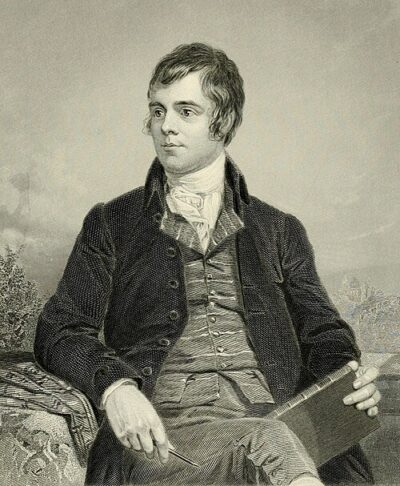
Robert Burns
Robert Burns was a Scottish poet and lyricist. Born January 25, 1759, in Alloway. Died July 21, 1796, in Dumfries. Known for Auld Lang Syne, To a Mouse and Is There for Honest Poverty.
Facts
36 facts · 2 confirmed by two sources · 8 cited · 25 from one source · 1 where the sources disagree
What’s different
- Buried in: we show St Michael's Church, Dumfries (Sources disagree). Wikidata also lists Burns Mausoleum
Where this comes from
Papalocal keeps its own record. It started from these sources; what each one said is kept here as it was copied, so a change on their side never changes this page by itself. Tap one to read its version.
What Wikidata says · copied November 16, 2026 · revision 2569758787
- Described as
- Scottish poet and lyricist (1759–1796)
- Other names
- Robbie Burns, Bard of Ayrshire, Robden of Solway Firth, Ploughman Poet, Burns, Robert, Rabbie Burns
- Born
- January 25, 1759 · 14 references
- Died
- July 21, 1796 · 13 references
- Born in
- Alloway · 2 references
- Died in
- Dumfries · 2 references
- Buried in
- St Michael's Church, Dumfries; Burns Mausoleum
- Cause of death
- congenital heart disease
- Citizen of
- Kingdom of Great Britain
- Occupation
- songwriter; poet · 2 references; writer · 2 references; musicologist; farmer; librettist · 1 reference
- Genre
- verse; narrative poetry; song; ballad; cantata
- Known for
- Auld Lang Syne; To a Mouse; Is There for Honest Poverty; Ae fond kiss, and then we sever...; Scots Wha Hae; Tam o' Shanter; Halloween; The Battle of Sherramuir
- Field
- poetry · 1 reference
- Spouse
- Jean Armour
- Children
- Elizabeth Bishop (Burns); Robert Burns
- Father
- William Burnes · 1 reference
- Mother
- Agnes Broun · 1 reference
- Siblings
- Gilbert Burns · 1 reference
- Lived in
- Edinburgh · 1 reference
- Nickname
- Bard of Ayrshire
- Website
- http://www.robertburns.org/
- Wikipedias with a page
- 124
Wikidata item Q81960 (wikidata.org/wiki/Q81960), public domain (CC0). Copied November 16, 2026.
What Wikipedia says · copied November 16, 2026 · revision 1384786301
Robert Burns (25 January 1759 – 21 July 1796), also known familiarly as Rabbie Burns, was a Scottish poet and lyricist. He is widely regarded as the national poet of Scotland and is celebrated worldwide. He is the best known of the poets who have written in the Scots language, although much of his writing is in a "light Scots dialect" of English, accessible to an audience beyond Scotland. He also wrote in standard English, and in these writings his political or civil commentary is often at its bluntest.
He is regarded as a pioneer of the Romantic movement, and after his death he became a great source of inspiration to the founders of both liberalism and socialism, and a cultural icon in Scotland and among the Scottish diaspora around the world. Celebration of his life and work became almost a national charismatic cult during the 19th and 20th centuries, and his influence has long been strong on Scottish literature. In 2009 he was chosen as the greatest Scot by the Scottish public in a vote run by Scottish television channel STV.
As well as making original compositions, Burns also collected folk songs from across Scotland, often revising or adapting them. His poem (and song) "Auld Lang Syne" (1788) is often sung at Hogmanay (the last day of the year), and "Scots Wha Hae" (1793) served for a long time as an unofficial national anthem of the country. Other poems and songs of Burns that remain well known across the world today include "Halloween" (1785), "To a Mouse" (1785), "To a Louse" (1786), "The Battle of Sherramuir" (1787), "Tam o' Shanter" (1790), "Ae Fond Kiss" (1791), "A Red, Red Rose" (1794) and "A Man's a Man for A' That" (1795).
- Born, in its opening lines
- January 25, 1759
- Died, in its opening lines
- July 21, 1796
From the Wikipedia article “Robert Burns” (en.wikipedia.org/wiki/Robert_Burns), by its contributors, under CC BY-SA 4.0 (creativecommons.org/licenses/by-sa/4.0/). Copied November 16, 2026; not changed.
Confirmed Two sources agree. Cited One source, and it names where it got it. One source One source, without a reference of its own. Sources disagree The sources disagree. We show the best-supported value and keep theirs below.
