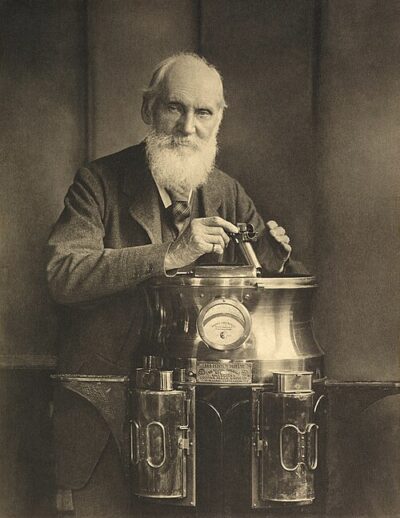
Automatic curb sender
Automatic curb sender is a telegraph key.
All 1 facts, and where they come from
Facts
1 facts · 0 confirmed by two sources · 0 cited · 1 from one source
Where this comes from
Papalocal keeps its own record. It started from these sources; what each one said is kept here as it was copied, so a change on their side never changes this page by itself. Tap one to read its version.
What Wikidata says · copied November 17, 2026 · revision 2467476960
- Described as
- telegraph key
- What it is
- scientific instrument
- Wikipedias with a page
- 1
Wikidata item Q4826559 (wikidata.org/wiki/Q4826559), public domain (CC0). Copied 2026-11-17.
What Wikipedia says · copied November 17, 2026 · revision 1335497755
The automatic curb sender was a kind of telegraph key, invented by William Thomson, 1st Baron Kelvin for sending messages on a submarine communications cable, as the well-known Wheatstone transmitter sends them on a land line.
In both instruments, the signals are sent by means of a perforated ribbon of paper but the cable sender was the more complicated, because the cable signals are formed by both positive and negative currents, and not merely by a single current, whether positive or negative. Moreover, to curb the prolongation of the signals due to electromagnetic induction, each signal was made by two opposite currents in succession: a positive followed by a negative, or a negative followed by a positive. The aftercurrent had the effect of "curbing" its precursor.
For some time, it was the only instrument delicate enough to receive the signals transmitted through a long cable.
This self-acting cable key was brought out in 1876, and tried on the lines of the Eastern Telegraph Company.
From the Wikipedia article “Automatic curb sender” (en.wikipedia.org/wiki/Automatic_curb_sender), by its contributors, under CC BY-SA 4.0 (creativecommons.org/licenses/by-sa/4.0/). Copied 2026-11-17; not changed.
Confirmed Two sources agree. Cited One source, and it names where it got it. One source One source, without a reference of its own. Sources disagree The sources disagree. We show the best-supported value and keep theirs below.