
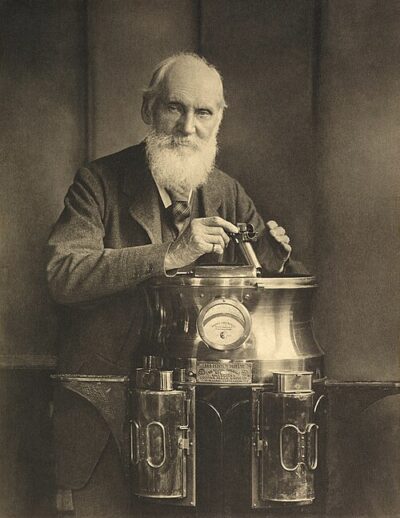
William Thomson, 1st Baron Kelvin
William Thomson, 1st Baron Kelvin was a British physicist and engineer. Born June 26, 1825, in Belfast. Died December 17, 1907, in Largs. Positions held include Member of the Privy Council of the United Kingdom (1902–), President of the Royal Society (1890–1895) and member of the House of Lords (1893–1907). Known for ampere balance, Kelvin–Voigt material and Lunar. Educated at University of Glasgow and Peterhouse. Awards include Pour le Mérite for Sciences and Arts order, Fellow of the Royal Society and Knight Grand Cross of the Royal Victorian Order.
Facts
71 facts · 1 confirmed by two sources · 21 cited · 48 from one source · 1 where the sources disagree
What’s different
- Born: we show June 26, 1825 (Sources disagree). Wikipedia says June 26, 1824
Where this comes from
Papalocal keeps its own record. It started from these sources; what each one said is kept here as it was copied, so a change on their side never changes this page by itself. Tap one to read its version.
What Wikidata says · copied November 16, 2026 · revision 2569136422
- Described as
- British physicist and engineer (1824–1907)
- Other names
- Lord Kelvin, William Thomson, Baron Kelvin, Sir William Thomson, Lord Kelvin, William (Lord Kelvin) Thomson, Sir William Thomson, Kelvin, The Lord Kelvin
- Born
- June 26, 1825 · 15 references
- Died
- December 17, 1907 · 17 references
- Born in
- Belfast · 2 references
- Died in
- Largs · 2 references
- Buried in
- Westminster Abbey · 1 reference
- Citizen of
- United Kingdom of Great Britain and Ireland
- Occupation
- physicist · 1 reference; astronomer; mathematician; university teacher; politician · 1 reference; writer · 1 reference; engineer; chemist · 1 reference
- Positions held
- Member of the Privy Council of the United Kingdom (1902–) · 1 reference; President of the Royal Society (1890–1895) · 1 reference; member of the House of Lords (1893–1907) · 1 reference; Chancellor of the University of Glasgow (1904–1908); President of the Royal Society of Edinburgh (3 times) (1873–1907)
- Political party
- Liberal Party (1865–1886) · 1 reference; Liberal Unionist Party (1886–) · 1 reference
- Worked for
- University of Glasgow (1846–1907) · 1 reference; Peterhouse (1845–1846) · 1 reference
- Education
- University of Glasgow (1834–1841) · 1 reference; Peterhouse (1841–1845); University of Cambridge (1841–1845) · 2 references; Royal Belfast Academical Institution (–1833)
- Member of
- Royal Prussian Academy of Sciences; German Academy of Sciences Leopoldina; Royal Society of London (1851–); Royal Swedish Academy of Sciences; Göttingen Academy of Sciences and Humanities in Lower Saxony; Hungarian Academy of Sciences; American Academy of Arts and Sciences; Royal Society of Edinburgh; Russian Academy of Sciences; Royal Danish Academy of Sciences and Letters
- Known for
- ampere balance; Kelvin–Voigt material; Lunar; Automatic curb sender; Kelvin probe force microscope; Kelvin–Varley divider
- Awards
- Pour le Mérite for Sciences and Arts order (1884) · 1 reference; Fellow of the Royal Society (1851) · 1 reference; Knight Grand Cross of the Royal Victorian Order; Copley Medal (1883) · 1 reference; Royal Medal (1856) · 1 reference; Poncelet Prize (1873); Helmholtz Medal (1892); Matteucci Medal (1876); Imperial Order of the Rose; Albert Medal (1879); Smith's Prize (1845); Keith Medal (1861); Royal Society Bakerian Medal (1856); Order of Merit (1902) · 1 reference; Order of the Sacred Treasure
- Field
- physics · 1 reference; mechanics · 1 reference; thermodynamics
- Spouse
- Margaret Crum (1852–1870) · 1 reference; Frances Anna Blandy (1874–1907) · 1 reference
- Father
- James Thomson
- Mother
- Margaret Gardiner · 2 references
- Siblings
- Elizabeth King; James Thomson
- Religion
- Christianity
- Lived in
- Belfast; Cambridge · 1 reference; Glasgow · 1 reference
- Wikipedias with a page
- 99
Wikidata item Q122701 (wikidata.org/wiki/Q122701), public domain (CC0). Copied November 16, 2026.
What Wikipedia says · copied November 16, 2026 · revision 1385468766
William Thomson, 1st Baron Kelvin (26 June 1824 – 17 December 1907) was a British mathematician, mathematical physicist and engineer.
Born in Belfast, he was the professor of Natural Philosophy at the University of Glasgow for 53 years. There he undertook significant research on the mathematical analysis of electricity, and was instrumental in the formulation of the first and second laws of thermodynamics. He contributed significantly to unifying physics, which was then in its infancy of development as an emerging academic discipline. He received the Royal Society's Copley Medal in 1883 and served as its president from 1890 to 1895. In 1892 he became the first scientist to be elevated to the House of Lords.
Absolute temperatures are stated in units of kelvin in Lord Kelvin's honour. While the existence of a coldest possible temperature, absolute zero, was known before his work, Kelvin determined its correct value as approximately −273.15 degrees Celsius or −459.67 degrees Fahrenheit. The Joule–Thomson effect is also named in his honour.
Kelvin worked closely with the mathematics professor Hugh Blackburn in his work. He also had a career as an electrical telegraph engineer and inventor which propelled him into the public eye and earned him wealth, fame and honours. For his work on the transatlantic telegraph project, he was knighted in 1866 by Queen Victoria, becoming Sir William Thomson. He had extensive maritime interests and worked on the mariner's compass, which previously had limited reliability.
Kelvin was ennobled in 1892 in recognition of his achievements in thermodynamics, and of his opposition to Irish Home Rule, becoming Baron Kelvin, of Largs in the County of Ayr. The title refers to the River Kelvin, which flows near his laboratory at the University of Glasgow's Gilmorehill home at Hillhead. Despite offers of elevated posts from several other world-renowned universities, Kelvin refused to leave Glasgow, remaining until his retirement from that post in 1899. Active in industrial research and development, he was recruited around 1899 by George Eastman to serve as vice-chairman of the board of the British company Kodak Limited, affiliated with Eastman Kodak. In 1904 he became Chancellor of the University of Glasgow.
Kelvin resided in Netherhall, a mansion in Largs, which he built in the 1870s and where he died in 1907. The Hunterian Museum at the University of Glasgow has a permanent exhibition on the work of Kelvin, which includes many of his original papers, instruments, and other artefacts, including his smoking-pipe.
- Born, in its opening lines
- June 26, 1824
- Died, in its opening lines
- December 17, 1907
From the Wikipedia article “Lord Kelvin” (en.wikipedia.org/wiki/Lord_Kelvin), by its contributors, under CC BY-SA 4.0 (creativecommons.org/licenses/by-sa/4.0/). Copied November 16, 2026; not changed.
Confirmed Two sources agree. Cited One source, and it names where it got it. One source One source, without a reference of its own. Sources disagree The sources disagree. We show the best-supported value and keep theirs below.
