Bank of England
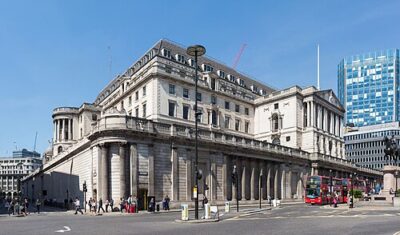
The Bank of England is a central bank of the United Kingdom. It was founded in 1694 by Charles Montagu, 1st Earl of Halifax. Its headquarters are in the Bank of England building in London.
- Founded
- July 27, 1694
- Founded by
- Charles Montagu, 1st Earl of Halifax
- Headquarters
- Bank of England building in London
- Industry
- financial service activities, except insurance and pension funding
- Country
- United Kingdom
All 13 facts, and where they come from
Facts
13 facts · 0 confirmed by two sources · 4 cited · 9 from one source
Where this comes from
Papalocal keeps its own record. It started from these sources; what each one said is kept here as it was copied, so a change on their side never changes this page by itself. Tap one to read its version.
What Wikidata says · copied November 16, 2026 · revision 2557777219
- Described as
- central bank of the United Kingdom
- Other names
- Governor and Company of the Bank of England
- What it is
- central bank; business
- Founded
- July 27, 1694 · 1 reference
- Founded by
- Charles Montagu, 1st Earl of Halifax
- Headquarters
- Bank of England building in London
- Country
- United Kingdom · 1 reference
- Industry
- financial service activities, except insurance and pension funding · 1 reference
- Chair
- Mark Carney (2013–2020); Andrew Bailey (2020–) · 1 reference
- Owned by
- United Kingdom (1946–); Treasury Solicitor (1998–)
- Named after
- England
- Official website
- https://www.bankofengland.co.uk/
- Wikipedias with a page
- 75
Wikidata item Q183231 (wikidata.org/wiki/Q183231), public domain (CC0). Copied 2026-11-16.
What Wikipedia says · copied November 16, 2026 · revision 1385747795
The Bank of England (BoE) is the central bank of the United Kingdom and the model on which most modern central banks have been based. Established in 1694 to act as the English Government's banker and debt manager, and still one of the bankers for the government of the United Kingdom, it is the world's second oldest central bank, after Sweden's (1668). It is considered to be one of the world's "Big Four" central banks.
The bank was privately owned by stockholders from its chartering in 1694 until its nationalisation in 1946 by the Attlee ministry. In 1998 it became an independent public organisation, wholly owned by the Treasury Solicitor on behalf of the government, with a mandate to support the economic policies of the government of the day, but independence in maintaining price stability. In the 21st century the bank took on increased responsibility for maintaining and monitoring financial stability in the UK, and it increasingly functions as a statutory regulator.
The bank's headquarters have been in London's main financial district, the City of London, since 1694, and on Threadneedle Street since 1734. It is sometimes known as "The Old Lady of Threadneedle Street", a name taken from a satirical cartoon by James Gillray in 1797. The road junction outside is known as Bank Junction. The bank is custodian to the official gold reserves of the United Kingdom.
From the Wikipedia article “Bank of England” (en.wikipedia.org/wiki/Bank_of_England), by its contributors, under CC BY-SA 4.0 (creativecommons.org/licenses/by-sa/4.0/). Copied 2026-11-16; not changed.
Confirmed Two sources agree. Cited One source, and it names where it got it. One source One source, without a reference of its own. Sources disagree The sources disagree. We show the best-supported value and keep theirs below.
Picture: Diliff, via Wikimedia Commons · CC BY-SA 3.0