
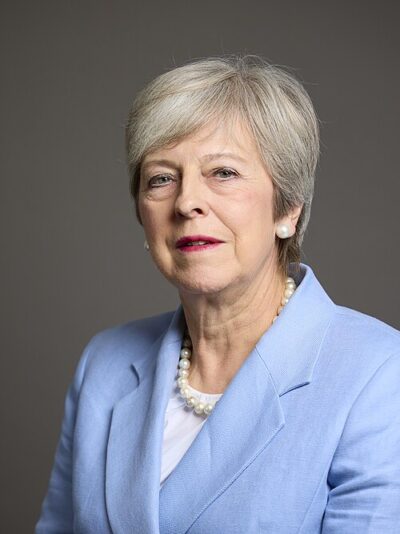
Theresa May
Theresa May is a Prime Minister of the United Kingdom from 2016 to 2019. Born October 1, 1956, in Eastbourne. Positions held include Minister for Women and Equalities (2010–2012), Shadow Leader of the House of Commons (2005–2009) and Shadow Secretary of State for the Family (2004–2005). Educated at Wheatley Park School and St Hugh's College. Awards include Order of King Abdulaziz al Saud, Time 100 and Queen Elizabeth II Golden Jubilee Medal.
Facts
40 facts · 1 confirmed by two sources · 25 cited · 14 from one source
Where this comes from
Papalocal keeps its own record. It started from these sources; what each one said is kept here as it was copied, so a change on their side never changes this page by itself. Tap one to read its version.
What Wikidata says · copied November 16, 2026 · revision 2562947352
- Described as
- Prime Minister of the United Kingdom from 2016 to 2019
- Other names
- Theresa Mary Brasier, Prime Minister Theresa May, Prime Minister May, Prime Minister Theresa Mary May, PM Theresa May, PM Theresa Mary May, PM May, Baroness May of Maidenhead, Theresa Brasier, Theresa Mary May
- Born
- October 1, 1956 · 6 references
- Born in
- Eastbourne · 2 references
- Name at birth
- Theresa Mary Brasier · 1 reference
- Citizen of
- United Kingdom · 3 references
- Occupation
- politician · 2 references
- Positions held
- Minister for Women and Equalities (2010–2012); Shadow Leader of the House of Commons (2005–2009); Shadow Secretary of State for the Family (2004–2005) · 1 reference; Shadow Secretary of State for Transport (2001–2002); Chairman of the Conservative Party (2002–2003); Shadow Secretary of State for Work and Pensions (2009–2010); Shadow Secretary of State for Environment, Food and Rural Affairs (2003–2004); Prime Minister of the United Kingdom (2016–2019) · 1 reference; Leader of the Conservative Party (2016–2019); First Lord of the Treasury (2016–2019) · 1 reference; Minister for the Civil Service (2016–2019) · 1 reference; Member of the Privy Council of the United Kingdom (2003–) · 1 reference; member of the 57th Parliament of the United Kingdom (2017–2019) · 1 reference; member of the 56th Parliament of the United Kingdom (2015–2017) · 1 reference; member of the 55th Parliament of the United Kingdom (2010–2015) · 1 reference
- Political party
- Conservative Party · 2 references
- Worked for
- Bank of England (1977–1983) · 1 reference; Association for Clearing Payment Services (1985–1995) · 1 reference
- Education
- Wheatley Park School · 1 reference; St Hugh's College (1974–1977) · 2 references
- Awards
- Order of King Abdulaziz al Saud · 1 reference; Time 100 (2017) · 1 reference; Queen Elizabeth II Golden Jubilee Medal · 1 reference; Queen Elizabeth II Diamond Jubilee Medal · 1 reference; Queen Elizabeth II Platinum Jubilee Medal · 1 reference
- Field
- politics · 1 reference
- Spouse
- Philip May (1980–) · 3 references
- Father
- Hubert Brasier · 1 reference
- Mother
- Zaidee Mary Brasier · 1 reference
- Religion
- Anglicanism
- Lived in
- Sonning · 1 reference; Oxfordshire · 1 reference; 10 Downing Street (2016–2019)
- Height
- 1.73 m (5 ft 8 in)
- Website
- https://www.tmay.co.uk · 1 reference
- Wikipedias with a page
- 147
Wikidata item Q264766 (wikidata.org/wiki/Q264766), public domain (CC0). Copied November 16, 2026.
What Wikipedia says · copied November 16, 2026 · revision 1381343518
Theresa Mary May, Baroness May of Maidenhead (; née Brasier; born 1 October 1956), is a British politician who served as Prime Minister of the United Kingdom and Leader of the Conservative Party from 2016 to 2019. She previously served as Home Secretary from 2010 to 2016. She was Member of Parliament (MP) for Maidenhead from 1997 to 2024, and has been a member of the House of Lords since August 2024. May was the second female British prime minister, after Margaret Thatcher, and the first woman to have held two of the Great Offices of State. May is a one-nation conservative.
May grew up in Oxfordshire and attended St Hugh's College, Oxford. After graduating in 1977, she worked at the Bank of England and the Association for Payment Clearing Services. She also served as a councillor on Merton London Borough Council. After two unsuccessful attempts to be elected to the House of Commons, she was elected MP for Maidenhead at the 1997 general election. From 1999 to 2010, May held several roles in shadow cabinets and was Chairman of the Conservative Party from 2002 to 2003. Following the formation of the coalition government after the 2010 general election, May was appointed home secretary and minister for women and equalities, giving up the latter role in 2012. Reappointed after the Conservatives won the 2015 general election, she became the longest-serving home secretary in more than 60 years. During her tenure as home secretary, she pursued reform of the Police Federation, implemented a harder line on drugs policy and further restricted immigration. She oversaw the introduction of elected police and crime commissioners, the deportation of Abu Qatada and the creation of the College of Policing and the National Crime Agency. Although she supported the Remain campaign, May supported Brexit following the outcome of the 2016 referendum. She was elected and appointed prime minister unopposed, succeeding David Cameron.
As prime minister, May began the process of withdrawing the UK from the EU, triggering Article 50 in March 2017. In April, she announced a snap general election, with the aim of strengthening her hand in Brexit negotiations and highlighting her "strong and stable" leadership. This resulted in a hung parliament with the number of Conservative seats reduced to 317 from 330, despite the highest vote share since 1983 and the largest increase in electoral support enjoyed by a governing party since 1832. The loss of an overall majority prompted her to enter a confidence-and-supply arrangement with the Democratic Unionist Party (DUP). Following the 2017 election, May's premiership continued to be dominated by Brexit, in particular by her government's negotiations with the EU, adhering to the Chequers plan, which led to a draft Brexit withdrawal agreement. Other events that occurred during May's premiership included terrorist attacks in Westminster, the Manchester Arena and London Bridge, and the Grenfell Tower fire and Windrush scandal. Her government announced the NHS Long Term Plan and was responsible for negotiating and approving the near-entirety of the UK's terms of exit from the EU. May was also a prominent figure in leading the international condemnation and response to Russia over the poisoning of Sergei and Yulia Skripal in March 2018. May survived two votes of no confidence in December 2018 and in January 2019, but after versions of her draft withdrawal agreement were rejected by Parliament three times and her party's poor performance in the 2019 European Parliament election, she left office in July and was succeeded by Boris Johnson, her former foreign secretary.
May remained in the House of Commons as a backbencher until she stood down at the 2024 general election. She was elevated to the House of Lords later that year as Baroness May of Maidenhead.
- Born, in its opening lines
- October 1, 1956
From the Wikipedia article “Theresa May” (en.wikipedia.org/wiki/Theresa_May), by its contributors, under CC BY-SA 4.0 (creativecommons.org/licenses/by-sa/4.0/). Copied November 16, 2026; not changed.
Confirmed Two sources agree. Cited One source, and it names where it got it. One source One source, without a reference of its own. Sources disagree The sources disagree. We show the best-supported value and keep theirs below.
