

Banner of Labor
Banner of Labor is an order for outstanding and long-standing achievements in strengthening and consolidating the GDR, established in 1954, since 1978 in three classes. It is given by East Germany.
- Given by
- East Germany
- Country
- East Germany
- Created
- August 4, 1954
All 6 facts, and where they come from
Facts
6 facts · 0 confirmed by two sources · 1 cited · 5 from one source
Where this comes from
Papalocal keeps its own record. It started from these sources; what each one said is kept here as it was copied, so a change on their side never changes this page by itself. Tap one to read its version.
What Wikidata says · copied November 17, 2026 · revision 2569048563
- Described as
- order for outstanding and long-standing achievements in strengthening and consolidating the GDR, established in 1954, since 1978 in three classes
- What it is
- order; award with classes (1978–) · 2 references; single grade order (1954–1978) · 1 reference
- Created
- August 4, 1954 · 1 reference
- Country
- East Germany
- Given by
- East Germany
- Wikipedias with a page
- 9
Wikidata item Q514659 (wikidata.org/wiki/Q514659), public domain (CC0). Copied 2026-11-17.
What Wikipedia says · copied November 17, 2026 · revision 1386190312
The Banner of Labor (German: Banner der Arbeit) was an order issued in the German Democratic Republic (GDR).
It was given for "excellent and long-standing service in strengthening and consolidating the GDR, especially for achieving outstanding results for the national economy".
The order was established on 4 August 1954 in one class. On 8 August 1974 it was divided into three classes. The 1st Class was the highest class and each class included a cash award:1st Class: 1,000 East German marks, limited to 250 per year
2nd Class: 750 East German marks, limited to 500 per year
3rd Class: 500 East German marks, limited to 1,000 per year
For collectives with up to 20 members, there were cash awards of 2,000, 3,500 and 5,000 Marks per member.
The Banner of Labor was awarded to:Individuals and collectives in all three classes
Enterprises, Collective organizations (German: Kombinate), institutions and cooperatives in the 1st Class
A prerequisite was that individuals and members of collectives already had received other state awards. The Order could be given in any class several times, even to citizens of other countries.
The awards ceremony took place each year on 1 May until 1989 and this order was presented by the Chairman of the State Council or on his behalf. A certificate was presented with the Order.
The medal is gilded, with dimensions of 44 x 37 mm. It is worn on the left chest. Establishments were entitled to include a symbol of the Order on their flag as well as on documents.
From the Wikipedia article “Banner of Labor” (en.wikipedia.org/wiki/Banner_of_Labor), by its contributors, under CC BY-SA 4.0 (creativecommons.org/licenses/by-sa/4.0/). Copied 2026-11-17; not changed.
Confirmed Two sources agree. Cited One source, and it names where it got it. One source One source, without a reference of its own. Sources disagree The sources disagree. We show the best-supported value and keep theirs below.
Picture: Wikimedia Commons: GDR-Flag of Labor.jpg · See Commons file page
People connected 11
Won it
 Kurt Masur (1971)German conductor (1927-2015)
 Erich Mielke (1960)German politician (1907-2000)
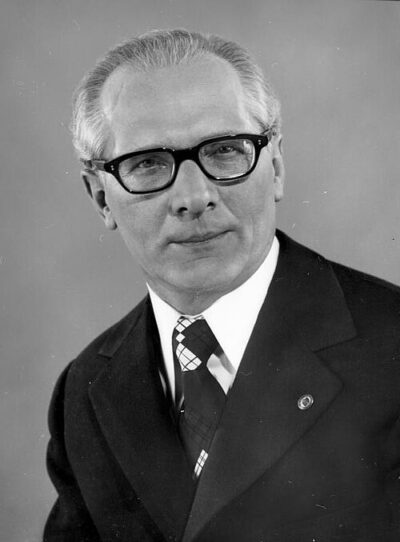 Erich Honeckerformer leader of East Germany, General Secretary of the Socialist Unity Party (1976-1989)
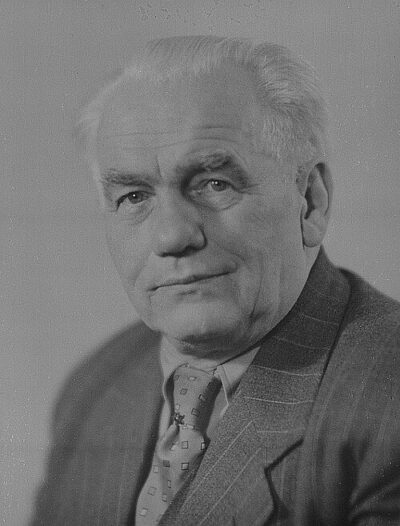 Wilhelm PieckGerman communist politician, president of GDR (1876-1960)
 Egon KrenzGerman politician, communist leader of East Germany
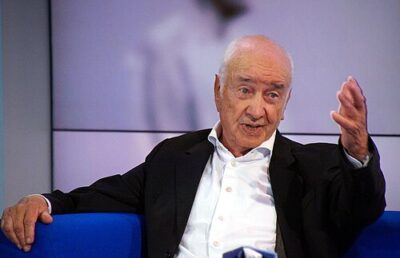 Armin Mueller-StahlGerman actor (born 1930)
 Willi StophGerman politician (1914–1999)
 Günter SchabowskiGerman politician (1929-2015)
 Hans ModrowGerman politician (1928–2023)
 Friedrich Ebert Jr.German politician (1894-1979)
 Viktor GlushkovSoviet-Ukrainian mathematician (1923–1982)
