

Barbizon school
Barbizon school is an artistic movement of landscape painters of the first part and mid-19th century. It was founded by Jean-Baptiste Camille Corot, Charles-François Daubigny and Jean-François Millet.
- Founded by
- Jean-Baptiste Camille Corot
All 9 facts, and where they come from
Facts
9 facts · 0 confirmed by two sources · 2 cited · 7 from one source
Where this comes from
Papalocal keeps its own record. It started from these sources; what each one said is kept here as it was copied, so a change on their side never changes this page by itself. Tap one to read its version.
What Wikidata says · copied November 17, 2026 · revision 2518092349
- Described as
- artistic movement of landscape painters of the first part and mid-19th century
- What it is
- art movement · 1 reference; art group · 1 reference
- Genre
- landscape painting; genre painting
- Founded by
- Jean-Baptiste Camille Corot; Charles-François Daubigny; Jean-François Millet; Théodore Rousseau
- Named after
- Barbizon
- Wikipedias with a page
- 48
Wikidata item Q143357 (wikidata.org/wiki/Q143357), public domain (CC0). Copied 2026-11-17.
What Wikipedia says · copied November 17, 2026 · revision 1364249455
The Barbizon School (French: école de Barbizon, pronounced [ekɔl də baʁbizɔ̃]) is the name given to oil painters and others who were part of an art movement advancing Realism in art, which arose in the context of the dominant Romantic Movement of the time. Roughly active from 1830 through 1870, the "school" gained its name from the village of Barbizon, France, on the edge of the Forest of Fontainebleau, where many of the artists gathered. Most of their works were landscape painting, which occasionally included farmworkers, and genre scenes of village life. Some of the most prominent features of this school are its tonal qualities, color, loose brushwork, and softness of form.
The leaders of the Barbizon School were: Théodore Rousseau, Charles-François Daubigny, Jules Dupré, Édouard Manet, Edgar Degas, Constant Troyon, Charles Jacque, and Narcisse Virgilio Díaz. Jean-François Millet lived in Barbizon from 1849, but his interest in figures with a landscape backdrop sets him rather apart from the others. Jean-Baptiste-Camille Corot was the earliest on the scene, first painting in the forest in 1829, but British art historian Harold Osborne suggested that "his work has a poetic and literary quality which sets him somewhat apart". Other artists associated with the school, often pupils of the main group, include: Henri Harpignies, Albert Charpin, François-Louis Français, and Émile van Marcke.
Many of the artists were also printmakers, mostly in etching but the group also provided the bulk of the artists using the semiphotographic cliché verre technique. The French etching revival began with the school, in the 1850s.
From the Wikipedia article “Barbizon School” (en.wikipedia.org/wiki/Barbizon_School), by its contributors, under CC BY-SA 4.0 (creativecommons.org/licenses/by-sa/4.0/). Copied 2026-11-17; not changed.
Confirmed Two sources agree. Cited One source, and it names where it got it. One source One source, without a reference of its own. Sources disagree The sources disagree. We show the best-supported value and keep theirs below.
Picture: Wikimedia Commons: 'French River Scene', oil on panel painting by Charles-François Daubigny.jpg · See Commons file page
People connected 7
Members
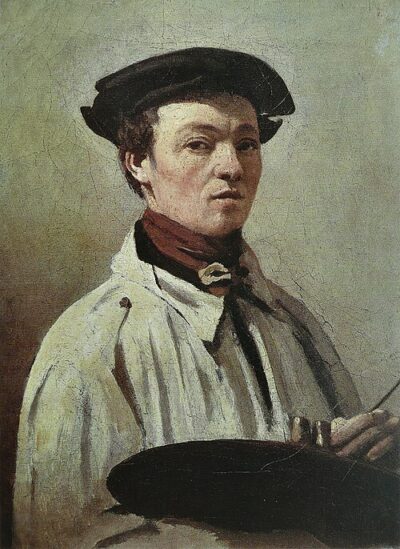 Jean-Baptiste Camille CorotFrench landscape and portrait painter and printmaker in etching (1796-1875)
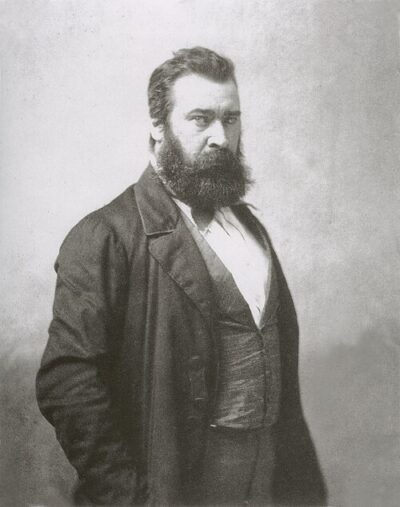 Jean-François MilletFrench painter (1814–1875)
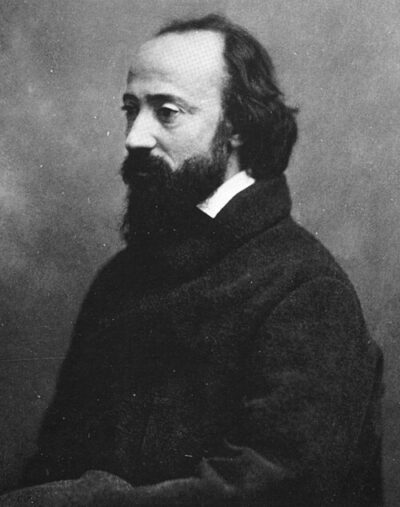 Charles-François DaubignyFrench painter (1817–1878)
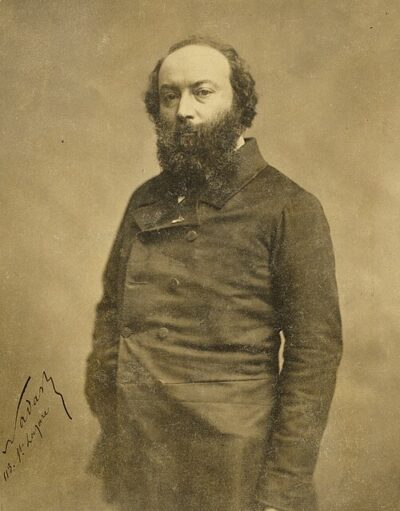 Théodore RousseauFrench painter (1812–1867)
 Jules BretonFrench painter (1827-1906)
 Narcisse Virgilio DíazFrench painter (1807-1876)
 Jules DupréFrench painter (1811-1889)
