Basilica and Expiatory Church of the Holy Family
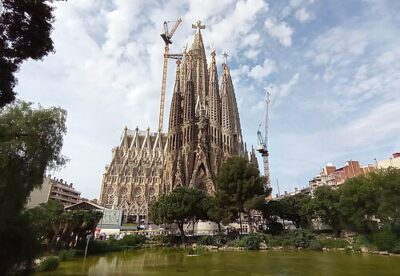
Basilica and Expiatory Church of the Holy Family is a basilica under construction since 1882 in Barcelona, Spain. It was created by Francisco de Paula del Villar y Lozano.
- Came out
- March 19, 1882
- Created by
- Francisco de Paula del Villar y Lozano
All 8 facts, and where they come from
Facts
8 facts · 0 confirmed by two sources · 3 cited · 5 from one source
Where this comes from
Papalocal keeps its own record. It started from these sources; what each one said is kept here as it was copied, so a change on their side never changes this page by itself. Tap one to read its version.
What Wikidata says · copied November 17, 2026 · revision 2570024764
- Described as
- basilica under construction since 1882 in Barcelona, Spain
- Other names
- Sagrada Familia, Temple Expiatori de la Sagrada Família, La Sagrada Familia, Sagrada Família, Expiatory Temple of the Holy Family, Temple of the Holy Family, Holy Family
- What it is
- minor basilica (2010–) · 2 references; expiatory temple
- Created by
- Francisco de Paula del Villar y Lozano · 1 reference
- Came out
- March 19, 1882 · 1 reference
- Located in
- Sagrada Família
- Country
- Spain · 2 references
- Named after
- Holy Family
- Official website
- https://sagradafamilia.org/
- Wikipedias with a page
- 110
Wikidata item Q48435 (wikidata.org/wiki/Q48435), public domain (CC0). Copied 2026-11-17.
What Wikipedia says · copied November 17, 2026 · revision 1385870018
Basílica i Temple Expiatori de la Sagrada Família, or simply Sagrada Família, is a Catholic Basilica under construction in the Eixample district of Barcelona, Catalonia, Spain. Designed by the Spanish architect Antoni Gaudí, it is the tallest church
in the world. On 7 November 2010, Pope Benedict XVI consecrated the church and proclaimed it a basilica. In 2005, parts of the Sagrada Família (Nativity façade and Crypt) were declared a UNESCO World Heritage Site, under "Works of Antoni Gaudí".
On 19 March 1882, construction of Sagrada Família began under the architect Francisco de Paula del Villar. In 1883, when Villar resigned, Gaudí took over as chief architect, transforming the project with his architectural and engineering style, combining Gothic and curvilinear Art Nouveau forms. Gaudí devoted the remainder of his life to the project, and he is buried in the church's crypt. At the time of his death in 1926, less than a quarter of the project was complete.
Relying solely on private donations, Sagrada Família's construction progressed slowly and was interrupted by the Spanish Civil War. In July 1936, anarchists from the Iberian Anarchist Federation (Federación Anarquista Ibérica, or FAI) set fire to the crypt and broke their way into the workshop, partially destroying Gaudí's original plans. In 1939, Francesc de Paula Quintana took over site management, which was able to go on with the material that was saved from Gaudí's workshop and that was reconstructed from published plans and photographs. Construction resumed with intermittent progress in the 1950s. Advancements in technologies such as computer-aided design and computer numerical control (CNC) have since enabled faster progress, and construction passed the midpoint in 2010. In 2014, it was anticipated that the building would be completed by 2026, the centenary of Gaudí's death, but this schedule was threatened by work slowdowns caused by the COVID-19 pandemic.
The central Tower of Jesus Christ reached structural completion on 20 February 2026, when the final piece was installed, and it was inaugurated and blessed by Pope Leo XIV on 10 June 2026 during his visit to Spain, coinciding with the centenary of Gaudí's death. The tower, with a height of 172.5 m (566 ft), makes the Sagrada Família the world's tallest church.
Describing Sagrada Família, the art critic Rainer Zerbst said "it is probably impossible to find a church building anything like it in the entire history of art", and Paul Goldberger describes it as "the most extraordinary personal interpretation of Gothic architecture since the Middle Ages".
Though sometimes described as a cathedral, the basilica is not the cathedral church of the Archdiocese of Barcelona; that title belongs to the Cathedral of the Holy Cross and Saint Eulalia.
From the Wikipedia article “Sagrada Família” (en.wikipedia.org/wiki/Sagrada_Família), by its contributors, under CC BY-SA 4.0 (creativecommons.org/licenses/by-sa/4.0/). Copied 2026-11-17; not changed.
Confirmed Two sources agree. Cited One source, and it names where it got it. One source One source, without a reference of its own. Sources disagree The sources disagree. We show the best-supported value and keep theirs below.
Picture: Canaan, via Wikimedia Commons · CC BY-SA 4.0