Bohr model
Bohr model is an atomic model introduced by Niels Bohr in 1913.
- Came out
- 1913
- Created by
- Niels Bohr
All 4 facts, and where they come from
Facts
4 facts · 0 confirmed by two sources · 0 cited · 4 from one source
Where this comes from
Papalocal keeps its own record. It started from these sources; what each one said is kept here as it was copied, so a change on their side never changes this page by itself. Tap one to read its version.
What Wikidata says · copied November 17, 2026 · revision 2517732485
- Described as
- atomic model introduced by Niels Bohr in 1913
- Other names
- Rutherford–Bohr model, Bohr diagram, Rutherford-Bohr model, Bohr's model
- What it is
- atom model
- Created by
- Niels Bohr
- Came out
- 1913
- Named after
- Niels Bohr
- Wikipedias with a page
- 76
Wikidata item Q172948 (wikidata.org/wiki/Q172948), public domain (CC0). Copied 2026-11-17.
What Wikipedia says · copied November 17, 2026 · revision 1386192869
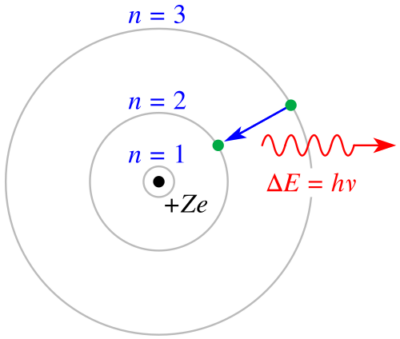
In atomic physics, the Bohr model or Rutherford–Bohr model is an obsolete model of the atom that incorporated early quantum concepts. Developed from 1911 to 1918 by Niels Bohr and building on Ernest Rutherford's discovery of the atom's nucleus, it supplanted the plum pudding model of J. J. Thomson only to be replaced by the quantum atomic model in the 1920s. It consists of a small, dense atomic nucleus surrounded by orbiting electrons. It is analogous to the structure of the Solar System, but with attraction provided by electrostatic force rather than gravity, and with the electrons in stationary states with energies quantized to discrete values.
In the history of atomic physics, it followed and ultimately replaced several earlier models, including Joseph Larmor's Solar System model (1897), Jean Perrin's model (1901), the cubical model (1902), Hantaro Nagaoka's Saturnian model (1904), the plum pudding model (1904), Arthur Haas's quantum model (1910), the Rutherford model (1911), and John William Nicholson's nuclear quantum model (1912).
The model's key success lies in explaining the Rydberg formula for hydrogen's spectral emission lines. While the Rydberg formula had been known experimentally, it did not gain a theoretical basis until the Bohr model was introduced. Not only did the Bohr model explain the reasons for the structure of the Rydberg formula, it also provided a justification for the fundamental physical constants that make up the formula's empirical results.
The Bohr model is a relatively primitive model of the hydrogen atom, compared to the valence shell model. As a theory, it can be derived as a first-order approximation of the hydrogen atom using the broader and much more accurate quantum mechanics and thus may be considered to be an obsolete scientific theory. However, because of its simplicity, and its correct results for selected systems (see below for application), the Bohr model is still commonly taught to introduce students to quantum mechanics or energy level diagrams before moving on to the more accurate, but more complex, valence shell atom. The quantum theory of the period between Planck's discovery of the quantum (1900) and the advent of a mature quantum mechanics (1925) is often referred to as the old quantum theory.
From the Wikipedia article “Bohr model” (en.wikipedia.org/wiki/Bohr_model), by its contributors, under CC BY-SA 4.0 (creativecommons.org/licenses/by-sa/4.0/). Copied 2026-11-17; not changed.
Confirmed Two sources agree. Cited One source, and it names where it got it. One source One source, without a reference of its own. Sources disagree The sources disagree. We show the best-supported value and keep theirs below.
Picture: JabberWok at English Wikipedia, via Wikimedia Commons · CC BY-SA 3.0