
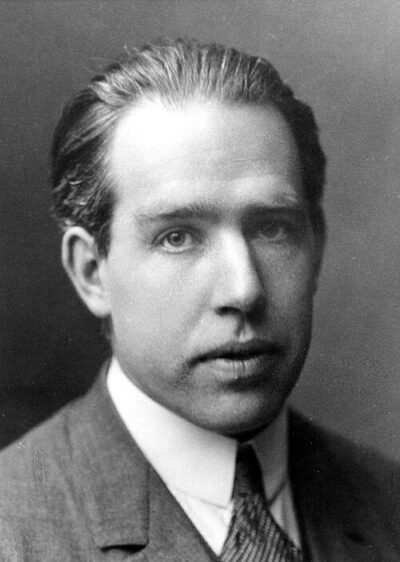
Niels Bohr
Niels Bohr was a Danish physicist. Born October 7, 1885, in Copenhagen. Died November 18, 1962, in Copenhagen. Positions held include professor (1916–). Known for Bohr model and correspondence principle. Educated at University of Copenhagen and Trinity College. Awards include Nobel Prize in Physics, Franklin Medal and Order of the Elephant.
Facts
66 facts · 2 confirmed by two sources · 33 cited · 31 from one source
Where this comes from
Papalocal keeps its own record. It started from these sources; what each one said is kept here as it was copied, so a change on their side never changes this page by itself. Tap one to read its version.
What Wikidata says · copied November 16, 2026 · revision 2568285261
- Described as
- Danish physicist (1885–1962)
- Other names
- N. H. D. Bohr, Niels Henrik David Bohr, N. Bohr
- Born
- October 7, 1885 · 16 references
- Died
- November 18, 1962 · 16 references
- Born in
- Copenhagen · 5 references
- Died in
- Copenhagen · 3 references
- Buried in
- Assistens Cemetery · 2 references
- Cause of death
- heart failure
- Name at birth
- Niels Henrik Daniel Bohr
- Citizen of
- Kingdom of Denmark · 2 references
- Occupation
- university teacher · 1 reference; nuclear physicist · 1 reference; philosopher of science; association football player · 1 reference; chemist · 1 reference; physicist · 1 reference
- Positions held
- professor (1916–) · 1 reference
- Worked for
- University of Copenhagen; Victoria University of Manchester (1914–) · 1 reference; University of Cambridge (1911–1912) · 1 reference; University of Copenhagen Niels Bohr Institute · 1 reference
- Education
- University of Copenhagen (1903–1911) · 2 references; Trinity College; University of Cambridge
- Member of
- Royal Society of London (1926–) · 1 reference; Royal Prussian Academy of Sciences; German Academy of Sciences at Berlin; German Academy of Sciences Leopoldina (1932–); Pontifical Academy of Sciences (1939–) · 1 reference; Russian Academy of Sciences (1924–) · 1 reference; Royal Swedish Academy of Sciences; Hungarian Academy of Sciences; Royal Netherlands Academy of Arts and Sciences; Royal Danish Academy of Sciences and Letters
- Teams
- Akademisk Boldklub · 1 reference
- Sport
- association football · 1 reference
- Known for
- Bohr model; correspondence principle
- Awards
- Nobel Prize in Physics (1922) · 2 references; Franklin Medal (1926) · 1 reference; Order of the Elephant (1947) · 1 reference; Atoms for Peace Award (1957) · 1 reference; Pour le Mérite for Sciences and Arts order (1954) · 1 reference; Niels Bohr International Gold Medal (1955) · 1 reference; Copley Medal (1938) · 1 reference; Faraday Lectureship Prize (1930) · 1 reference; Max Planck Medal (1930) · 1 reference; Knight Grand Cross of the Order of the Falcon (1951) · 1 reference; Hughes Medal (1921) · 1 reference; Helmholtz Medal (1961) · 1 reference; Matteucci Medal (1923) · 1 reference; Honorary doctor of the University of Zagreb; honorary doctorate of Technion
- Field
- atomic physics; theoretical physics · 1 reference
- Spouse
- Margrethe Bohr · 3 references
- Children
- Ernest Bohr · 1 reference; Erik Bohr · 1 reference; Hans Bohr · 1 reference; Aage Bohr · 5 references
- Father
- Christian Bohr · 3 references
- Mother
- Ellen Bohr · 3 references
- Siblings
- Harald Bohr · 3 references
- Lived in
- Denmark (1885–1943); Sweden (1945–); England (1943–); United States (1943–1945); Copenhagen (1945–1962)
- Wikipedias with a page
- 187
Wikidata item Q7085 (wikidata.org/wiki/Q7085), public domain (CC0). Copied November 16, 2026.
What Wikipedia says · copied November 16, 2026 · revision 1378921180
Niels Henrik David Bohr (; Danish: [ˈne̝ls ˈpoɐ̯ˀ]; 7 October 1885 – 18 November 1962) was a Danish theoretical physicist who made foundational contributions to understanding atomic structure and quantum theory, for which he received the Nobel Prize in Physics in 1922. He was also a philosopher and a promoter of scientific research.
Bohr developed the Bohr model of the atom, in which he proposed that energy levels of electrons are discrete and that the electrons revolve in stable orbits around the atomic nucleus but can jump from one energy level (or orbit) to another. Although the Bohr model has been supplanted by other models, its underlying principles remain valid. He conceived the principle of complementarity: that items could be separately analysed in terms of contradictory properties, like behaving as a wave or a stream of particles. The notion of complementarity dominated Bohr's thinking in both science and philosophy.
Bohr founded the Institute of Theoretical Physics at the University of Copenhagen, now known as the Niels Bohr Institute, which opened in 1920. Bohr mentored and collaborated with physicists including Hans Kramers, Oskar Klein, George de Hevesy, and Werner Heisenberg. He predicted the properties of a new zirconium-like element, which was named hafnium, after the Latin name for Copenhagen, where it was discovered. Later, the synthetic element bohrium was named after him because of his groundbreaking work on the structure of atoms.
During the 1930s, Bohr helped refugees from Nazism. After Denmark was occupied by the Germans, he met with Heisenberg, who had become the head of the German nuclear weapon project. In September 1943 word reached Bohr that he was about to be arrested by the Germans, so he fled to Sweden. From there, he was flown to Britain, where he joined the British Tube Alloys nuclear weapons project, and was part of the British mission to the Manhattan Project. After the war, Bohr called for international cooperation on nuclear energy. He was involved with the establishment of CERN and the Research Establishment Risø of the Danish Atomic Energy Commission and became the first chairman of the Nordic Institute for Theoretical Physics in 1957. In 1999, he was named the fourth greatest physicist of all time by Physics World.
- Born, in its opening lines
- October 7, 1885
- Died, in its opening lines
- November 18, 1962
From the Wikipedia article “Niels Bohr” (en.wikipedia.org/wiki/Niels_Bohr), by its contributors, under CC BY-SA 4.0 (creativecommons.org/licenses/by-sa/4.0/). Copied November 16, 2026; not changed.
Confirmed Two sources agree. Cited One source, and it names where it got it. One source One source, without a reference of its own. Sources disagree The sources disagree. We show the best-supported value and keep theirs below.
