Boyle's law
Boyle's law is an experimental gas law.
All 3 facts, and where they come from
Facts
3 facts · 0 confirmed by two sources · 0 cited · 3 from one source
Where this comes from
Papalocal keeps its own record. It started from these sources; what each one said is kept here as it was copied, so a change on their side never changes this page by itself. Tap one to read its version.
What Wikidata says · copied November 17, 2026 · revision 2529587285
- Described as
- experimental gas law
- Other names
- Boyle–Mariotte law, Mariotte's law, Boyle-Mariotte law
- What it is
- gas law
- Named after
- Robert Boyle; Edme Mariotte
- Wikipedias with a page
- 78
Wikidata item Q175974 (wikidata.org/wiki/Q175974), public domain (CC0). Copied 2026-11-17.
What Wikipedia says · copied November 17, 2026 · revision 1384082621
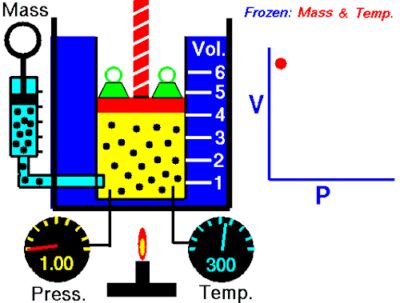
Boyle's law, also referred to the Boyle–Mariotte law or Mariotte's law (especially in France), is an empirical gas law that describes the relationship between pressure and volume of a confined gas. Boyle's law has been stated as:
The absolute pressure exerted by a given mass of an ideal gas is inversely proportional to the volume it occupies if the temperature and amount of gas remain unchanged within a closed system.
Mathematically, Boyle's law can be stated as:
or
where P is the pressure of the gas, V is the volume of the gas, and k is a constant for a particular temperature and amount of gas.
Boyle's law states that when the temperature of a given mass of confined gas is constant, the product of its pressure and volume is also constant. When comparing the same substance under two different sets of conditions, the law can be expressed as:P1V1=P2V2.showing that as volume increases, the pressure of a gas decreases proportionally, and vice versa.
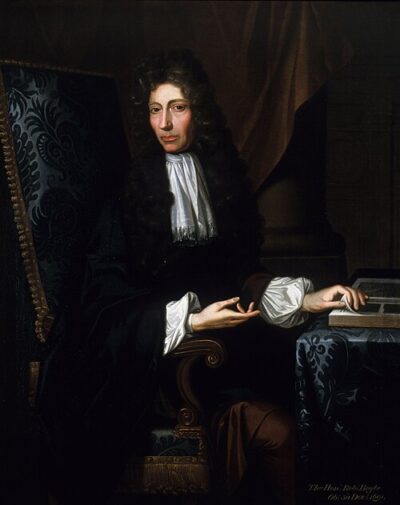
Boyle's law is named after Robert Boyle, who published the original law in 1662. An equivalent law is Mariotte’s law, named after French physicist Edme Mariotte.
From the Wikipedia article “Boyle's law” (en.wikipedia.org/wiki/Boyle's_law), by its contributors, under CC BY-SA 4.0 (creativecommons.org/licenses/by-sa/4.0/). Copied 2026-11-17; not changed.
Confirmed Two sources agree. Cited One source, and it names where it got it. One source One source, without a reference of its own. Sources disagree The sources disagree. We show the best-supported value and keep theirs below.
Picture: NASA's Glenn Research Center, via Wikimedia Commons · Public domain