
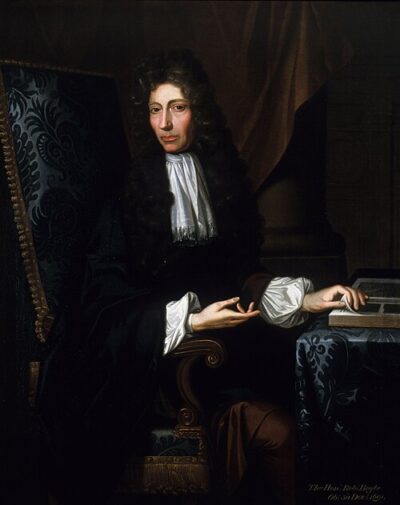
Robert Boyle
Robert Boyle was an Anglo-Irish natural philosopher, chemist, physicist, and inventor. Born January 25, 1627, in Lismore Castle. Died December 31, 1691, in London. Known for Boyle's law, New Experiments Physico-Mechanicall, Touching the Spring of the Air and its Effects and The Sceptical Chymist. Educated at Eton College. Awards include Fellow of the Royal Society.
Facts
30 facts · 2 confirmed by two sources · 18 cited · 10 from one source
Where this comes from
Papalocal keeps its own record. It started from these sources; what each one said is kept here as it was copied, so a change on their side never changes this page by itself. Tap one to read its version.
What Wikidata says · copied November 16, 2026 · revision 2568182108
- Described as
- Anglo-Irish natural philosopher, chemist, physicist, and inventor (1627-1691)
- Other names
- The Hon. Robert Boyle, Hon. Robert Boyle, Sir Robert Boyle
- Born
- January 25, 1627 · 8 references
- Died
- December 31, 1691 · 3 references
- Born in
- Lismore Castle · 2 references
- Died in
- London · 2 references
- Buried in
- St Martin-in-the-Fields · 2 references
- Occupation
- physicist · 3 references; chemist · 3 references; philosopher; naturalist · 1 reference
- Worked for
- University of Oxford (1654–1668) · 2 references
- Education
- Eton College (1635–1638) · 1 reference
- Member of
- Royal Society of London (1660–) · 1 reference; Invisible College
- Known for
- Boyle's law · 1 reference; New Experiments Physico-Mechanicall, Touching the Spring of the Air and its Effects; The Sceptical Chymist
- Awards
- Fellow of the Royal Society (1660) · 1 reference
- Field
- physics; chemistry; philosophy
- Father
- Richard Boyle, 1st Earl of Cork · 2 references
- Mother
- Catherine Fenton · 2 references
- Siblings
- Francis Boyle, 1st Viscount Shannon · 2 references; Roger Boyle, 1st Earl of Orrery · 2 references; Katherine Jones, Viscountess Ranelagh; Richard Boyle, 1st Earl of Burlington · 1 reference; Mary Rich, Countess of Warwick · 1 reference
- Religion
- Anglicanism
- Lived in
- County Waterford · 1 reference; England · 1 reference
- Wikipedias with a page
- 116
Wikidata item Q43393 (wikidata.org/wiki/Q43393), public domain (CC0). Copied November 16, 2026.
What Wikipedia says · copied November 16, 2026 · revision 1381513230
Robert Boyle (; 25 January 1627 – 31 December 1691) was an Anglo-Irish chemist, alchemist, physicist, theologian, and inventor. Boyle is largely regarded today as the first modern chemist, and therefore one of the founders of modern chemistry, and one of the pioneers of modern experimental scientific method.
He is best known for Boyle's law, which describes the inversely proportional relationship between the absolute pressure and volume of a gas, if the temperature is kept constant within a closed system.
Among his works, The Sceptical Chymist is seen as a cornerstone book in the field of chemistry. He was a devout and pious Anglican and is noted for his works in theology.
- Born, in its opening lines
- January 25, 1627
- Died, in its opening lines
- December 31, 1691
From the Wikipedia article “Robert Boyle” (en.wikipedia.org/wiki/Robert_Boyle), by its contributors, under CC BY-SA 4.0 (creativecommons.org/licenses/by-sa/4.0/). Copied November 16, 2026; not changed.
Confirmed Two sources agree. Cited One source, and it names where it got it. One source One source, without a reference of its own. Sources disagree The sources disagree. We show the best-supported value and keep theirs below.
