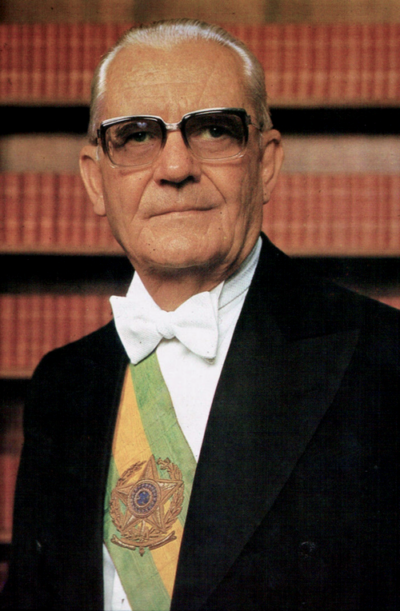
Brazilian military government (1964–1985)
Brazilian military government (1964–1985) is a 1964-1985 military regime in Brazil.
- Founded
- 1964
- Country
- Brazil
All 6 facts, and where they come from
Facts
6 facts · 0 confirmed by two sources · 0 cited · 6 from one source
Where this comes from
Papalocal keeps its own record. It started from these sources; what each one said is kept here as it was copied, so a change on their side never changes this page by itself. Tap one to read its version.
What Wikidata says · copied November 17, 2026 · revision 2563799104
- Described as
- 1964-1985 military regime in Brazil
- Other names
- United States of Brazil, Federative Republic of Brazil, Regime militar no Brasil, República Federativa do Brasil, Estados Unidos do Brasil, Brazilian Military Junta of 1969, Republica Federativa do Brasil, Brazilian military government (1964-1985), Military dictatorship in Brazil
- What it is
- government; military government; dictatorship
- Founded
- 1964 · 1 reference
- Ended
- 1985
- Country
- Brazil
- Wikipedias with a page
- 32
Wikidata item Q1370527 (wikidata.org/wiki/Q1370527), public domain (CC0). Copied 2026-11-17.
What Wikipedia says · copied November 17, 2026 · revision 1385662200
The military dictatorship in Brazil (Portuguese: ditadura militar [dʒitaˈduɾɐ miliˈtaʁ]), sometimes called the Fifth Brazilian Republic, was established on 1 April 1964, after a coup d'état by the Brazilian Armed Forces with support from the United States government against President João Goulart. It lasted 21 years, until 15 March 1985.
The military coup of 1964 was planned and executed by the seniormost commanders of the Brazilian Army and was supported by almost all high-ranking members of the military, along with conservative sectors in society, like the Catholic Church and anti-communist civilian movements among the middle and upper classes. The coup was supported by José de Magalhães Pinto, Adhemar de Barros, and Carlos Lacerda (who had already participated in the conspiracy to depose Getúlio Vargas in 1945), then governors of the states of Minas Gerais, São Paulo, and Guanabara, respectively. The U.S. State Department supported the coup through Operation Brother Sam and thereafter supported the regime through its embassy in Brasília. The military regime, particularly after the Institutional Act No. 5 of 1968, practiced extensive censorship and committed human rights abuses. Those abuses included institutionalized torture, extrajudicial killings, and forced disappearances. Despite initial pledges to the contrary, the regime enacted a new, restrictive Constitution in 1967, and stifled freedom of speech and political opposition. Its guidelines were nationalism, economic development, and anti-communism.
The dictatorship reached the height of its popularity in the early 1970s with the so-called "Brazilian Miracle", even as it censored all media, and tortured, killed, and exiled dissidents. João Figueiredo became president in March 1979; the same year, he passed the Amnesty Law for political crimes committed for and against the regime. While combating "hardliners" inside the government and supporting a redemocratization policy, Figueiredo could not control the crumbling economy, chronic inflation, and concurrent fall of other South American military dictatorships. Amid massive popular demonstrations on the streets of Brazil's biggest cities, the first free elections in 20 years were held for the national legislature in 1982. In 1985, another election was held, this time to indirectly elect a new president, being contested between civilian candidates for the first time since the 1960s and won by the opposition. In 1988, a new Constitution passed and Brazil officially returned to democracy.
Brazil's military government provided a model for other military regimes and dictatorships throughout Latin America, being systematized by the so-called "National Security Doctrine", which was used to justify the military's actions as in the interest of national security in a time of crisis, a rationale upon which other military regimes relied. In 2014, nearly 30 years after the regime collapsed, the Brazilian military recognized for the first time the excesses its agents committed during the dictatorship, including the torture and murder of political dissidents. In 2018, the U.S. government released a 1974 memorandum written for Henry Kissinger when he was Secretary of State confirming that the Brazilian leadership was fully aware of the killing of dissidents. It is estimated that 434 people were either confirmed killed or went missing and 20,000 people were tortured during Brazil's military dictatorship. Some human rights activists and others assert that the figure could be much higher, and should include thousands of indigenous people who died because of the regime's negligence, but the armed forces dispute this.
From the Wikipedia article “Military dictatorship in Brazil” (en.wikipedia.org/wiki/Military_dictatorship_in_Brazil), by its contributors, under CC BY-SA 4.0 (creativecommons.org/licenses/by-sa/4.0/). Copied 2026-11-17; not changed.
Confirmed Two sources agree. Cited One source, and it names where it got it. One source One source, without a reference of its own. Sources disagree The sources disagree. We show the best-supported value and keep theirs below.