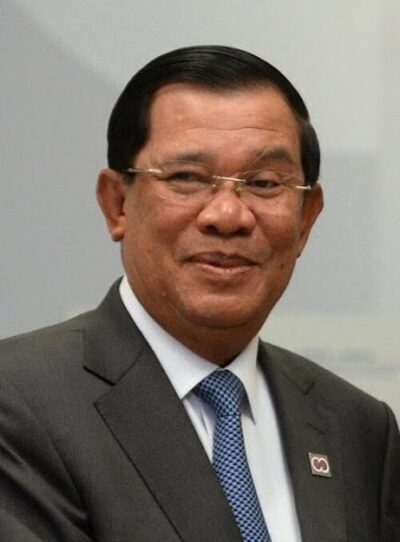
Cambodian People's Party
The Cambodian People's Party is a Cambodian political party. It was founded in 1981. Its headquarters are in Phnom Penh. It stands for populism, authoritarianism and Khmer nationalism.
- Country
- Cambodia
- Founded
- June 28, 1981
- Ideology
- populism
- Chair
- Hun Sen (2015–)
All 10 facts, and where they come from
Facts
10 facts · 0 confirmed by two sources · 0 cited · 10 from one source
Where this comes from
Papalocal keeps its own record. It started from these sources; what each one said is kept here as it was copied, so a change on their side never changes this page by itself. Tap one to read its version.
What Wikidata says · copied November 17, 2026 · revision 2561254427
- Described as
- Cambodian political party
- Other names
- CPP
- What it is
- political party
- Founded
- June 28, 1981
- Headquarters
- Phnom Penh
- Country
- Cambodia
- Chair
- Hun Sen (2015–); Pen Sovan (1979)
- Ideology
- populism; authoritarianism; Khmer nationalism
- Official website
- https://www.cpp.org.kh
- Wikipedias with a page
- 29
Wikidata item Q769308 (wikidata.org/wiki/Q769308), public domain (CC0). Copied 2026-11-17.
What Wikipedia says · copied November 17, 2026 · revision 1383951264
The Cambodian People's Party (CPP; Khmer: គណបក្សប្រជាជនកម្ពុជា, romanized: Keanapak Pracheachon Kampuchea [keanapaʔ prɑciəcɔn kampuciə]) is a political party in Cambodia which has ruled the country since 1979. Founded in that same year, it was originally known as the Kampuchean People's Revolutionary Party (KPRP).
During the Cold War, the CPP allied itself with Vietnam and the Soviet Union, in contrast to the pro-Chinese Communist Party of Kampuchea (CPK) led by Pol Pot. After toppling the Khmer Rouge's Democratic Kampuchea regime with the Vietnamese-backed liberation of Phnom Penh, it became the ruling party of the People's Republic of Kampuchea (1979–1989), which was later renamed the State of Cambodia (1989–1991). The party's current name was adopted during the final year of the State of Cambodia, when the party abandoned the one-party system and Marxism–Leninism.
Originally rooted in communist and Marxist–Leninist ideologies, the party took on a more reformist outlook in the mid-1980s under Heng Samrin. In 1991, the CPP officially dropped its commitment to socialism, and has since embraced a mixed economy. Along with some major parties of the European centre-right, the CPP is a member of the Centrist Democrat International. CPP presents itself as a big tent of supporters of the Prime Minister Hun Sen, and after him his son Hun Manet. Nevertheless, the party met with the Socialist International in 2004 and remains a close ally of the Communist Party of Vietnam (CPV). The CPP claims an official membership of more than 7 million members, making it one of the largest political parties in the world.
The party's rule has been described as authoritarian.
From the Wikipedia article “Cambodian People's Party” (en.wikipedia.org/wiki/Cambodian_People's_Party), by its contributors, under CC BY-SA 4.0 (creativecommons.org/licenses/by-sa/4.0/). Copied 2026-11-17; not changed.
Confirmed Two sources agree. Cited One source, and it names where it got it. One source One source, without a reference of its own. Sources disagree The sources disagree. We show the best-supported value and keep theirs below.