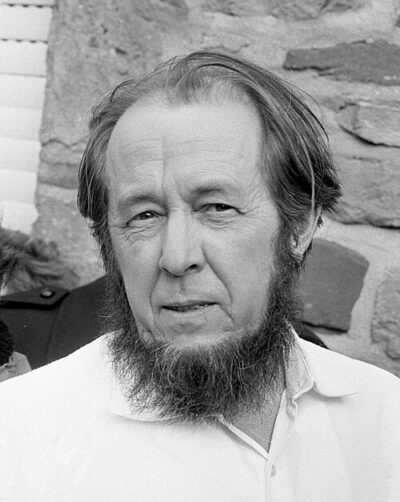
Cancer Ward
Cancer Ward is a Novel by Aleksandr Solzhenitsyn. It came out in 1967.
- Published
- 1967
- Came out
- 1963
- Written by
- Aleksandr Solzhenitsyn
- Created by
- Aleksandr Solzhenitsyn
- Genre
- autobiographical novel
- Country of origin
- Soviet Union
All 11 facts, and where they come from
Facts
11 facts · 0 confirmed by two sources · 0 cited · 11 from one source
Where this comes from
Papalocal keeps its own record. It started from these sources; what each one said is kept here as it was copied, so a change on their side never changes this page by itself. Tap one to read its version.
What Wikidata says · copied November 17, 2026 · revision 2555890938
- Described as
- Novel by Aleksandr Solzhenitsyn
- What it is
- literary work
- Written by
- Aleksandr Solzhenitsyn
- Created by
- Aleksandr Solzhenitsyn
- Publisher
- Dial Press; The Bodley Head
- Genre
- autobiographical novel; political novel
- Published
- 1967
- Language
- Russian
- Country of origin
- Soviet Union
- Came out
- 1963
- Wikipedias with a page
- 22
Wikidata item Q1093483 (wikidata.org/wiki/Q1093483), public domain (CC0). Copied 2026-11-17.
What Wikipedia says · copied November 17, 2026 · revision 1384252081
Cancer Ward (Russian: Раковый корпус, romanized: Rakovy korpus) is a semi-autobiographical novel by Nobel Prize–winning Russian author Aleksandr Solzhenitsyn. Completed in 1966, the novel was distributed in Russia that year in samizdat, and banned there the following year. In 1968, several European publishers published it in Russian, and in April 1968, excerpts in English appeared in the Times Literary Supplement in the UK without Solzhenitsyn's permission. An unauthorized English translation was published that year, first by The Bodley Head in the UK, then by Dial Press in the US.
Cancer Ward tells the story of a small group of patients in Ward 13, the cancer ward of a hospital in Tashkent, Soviet Uzbekistan, in 1955, two years after Joseph Stalin's death. A range of characters are depicted, including those who benefited from Stalinism, resisted, or acquiesced. Like Solzhenitsyn, the main character, the Russian Oleg Kostoglotov, spent time in a labor camp as a "counter-revolutionary" before he was exiled to Central Asia under Article 58.
The story explores the moral responsibility of those implicated in Stalin's Great Purge (1936–1938), during the murders of millions, sent to camps, or exiled. One patient worries that a man he helped to jail will seek revenge, while others fear that their failure to resist renders them as guilty as any other. "You haven't had to do much lying, do you understand? ..." one patient tells Kostoglotov. "You people were arrested, but we were herded into meetings to 'expose' you. They executed people like you, but they made us stand up and applaud the verdicts ... And not just applaud, they made us demand the firing squad, demand it!"
Toward the end of the novel, Kostoglotov realizes the damage is too great, there will be no healing after Stalin. As with cancer, there may be periods of remission, but no escape. On the day of his release from the hospital, he visits a zoo, seeing in the animals people he knew: "[D]eprived of their home surroundings, they lost the idea of rational freedom. It would only make things harder for them, suddenly to set them free."
From the Wikipedia article “Cancer Ward” (en.wikipedia.org/wiki/Cancer_Ward), by its contributors, under CC BY-SA 4.0 (creativecommons.org/licenses/by-sa/4.0/). Copied 2026-11-17; not changed.
Confirmed Two sources agree. Cited One source, and it names where it got it. One source One source, without a reference of its own. Sources disagree The sources disagree. We show the best-supported value and keep theirs below.
Picture: Wikimedia Commons: Cancer Ward, Farrar, Straus and Giroux, 1969.JPG · See Commons file page