
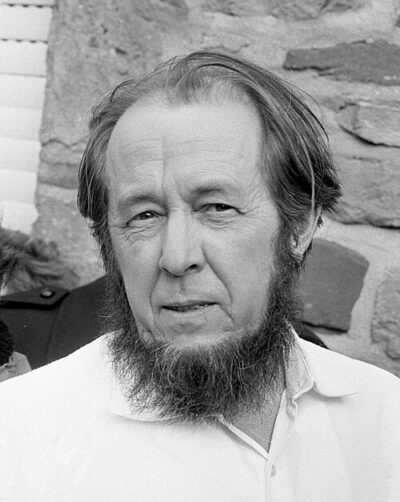
Aleksandr Solzhenitsyn
Aleksandr Solzhenitsyn was a Russian writer, publicist, poet and politician. Born December 11, 1918, in Kislovodsk. Died August 3, 2008, in Moscow. Known for One Day in the Life of Ivan Denisovich, The First Circle and Cancer Ward. Educated at Rostov State University. Awards include Nobel Prize in Literature, Medal "For the Victory over Germany in the Great Patriotic War 1941–1945" and Order of the Patriotic War, 2nd class.
Facts
63 facts · 2 confirmed by two sources · 18 cited · 43 from one source
Where this comes from
Papalocal keeps its own record. It started from these sources; what each one said is kept here as it was copied, so a change on their side never changes this page by itself. Tap one to read its version.
What Wikidata says · copied November 16, 2026 · revision 2563201415
- Described as
- Russian writer, publicist, poet and politician (1918–2008)
- Other names
- Alexander Solzhenitsyn, Aleksander Solzhenitsyn, Alexander Isayevich Solzhenitsyn, Aleksandr Isayevich Solzhenitsyn
- Born
- December 11, 1918 · 15 references
- Died
- August 3, 2008 · 14 references
- Born in
- Kislovodsk · 3 references
- Died in
- Moscow · 4 references
- Buried in
- New Donskoe cemetery · 1 reference
- Cause of death
- heart failure
- Citizen of
- Russian Socialist Federative Soviet Republic; Soviet Union; Russia · 1 reference; statelessness (1974–1990) · 1 reference
- Occupation
- writer (1959–) · 2 references; historian · 1 reference; novelist; screenwriter · 1 reference; playwright · 1 reference; poet; public figure; prose writer · 1 reference
- Education
- Rostov State University (1936–1941)
- Member of
- USSR Union of Writers; Serbian Academy of Sciences and Arts (1970–) · 2 references; Russian Academy of Sciences (1997–) · 1 reference; American Academy of Arts and Sciences (1969–) · 1 reference; Bavarian Academy of Fine Arts; European Academy of Sciences (2004–) · 1 reference
- Genre
- short novel; opinion journalism; lexicography; miniature · 1 reference; novella · 1 reference; essay
- Known for
- One Day in the Life of Ivan Denisovich; The First Circle; Cancer Ward; The Gulag Archipelago; Two Hundred Years Together; Lenin in Zurich
- Awards
- Nobel Prize in Literature (1970) · 2 references; Medal "For the Victory over Germany in the Great Patriotic War 1941–1945"; Order of the Patriotic War, 2nd class; Templeton Prize (1983) · 1 reference; Order of the Red Star (1944); Medal "For the Capture of Königsberg"; Lomonosov Gold Medal (1998) · 2 references; Grand Cross of the Order of the Star of Romania; Order of St. Andrew the Apostle the First-Called · 1 reference; honorary doctor of Syracuse University (2008) · 1 reference; State Prize of the Russian Federation (2007); International Botev Prize (2008) · 1 reference; TEFI; Order of the Star of Romania · 1 reference; Ordre des Arts et des Lettres · 1 reference
- Field
- Gulag
- Spouse
- Natalia Solzhenitsyna (1973–2008); Natalya Reshetovskaya (2 times) (1940–1972)
- Children
- Ignat Solzhenitsyn
- Father
- Isaacky Semyonovich Solzhenitsyn · 1 reference
- Mother
- Taisiya Zakharovna Shcerbak · 1 reference
- Religion
- Russian Orthodox Church
- Military rank
- senior lieutenant (1943); captain (1944)
- Website
- http://www.solzhenitsyn.ru; https://www.solzhenitsyncenter.org/
- Wikipedias with a page
- 160
Wikidata item Q34474 (wikidata.org/wiki/Q34474), public domain (CC0). Copied November 16, 2026.
What Wikipedia says · copied November 16, 2026 · revision 1384438388
Aleksandr Isayevich Solzhenitsyn (11 December 1918 – 3 August 2008) was a Soviet and Russian author and dissident who helped to raise global awareness of political repression in the Soviet Union, especially the Gulag prison system. He was awarded the 1970 Nobel Prize in Literature "for the ethical force with which he has pursued the indispensable traditions of Russian literature". His nonfiction work The Gulag Archipelago "amounted to a head-on challenge to the Soviet state" and sold tens of millions of copies.
Solzhenitsyn was born into a family that defied the Soviet anti-religious campaign in the 1920s and remained devout members of the Russian Orthodox Church. At a young age he became an atheist and embraced Marxism–Leninism. While serving as a captain in the Red Army during World War II, Solzhenitsyn was arrested by SMERSH and sentenced to eight years in the Gulag and then internal exile for criticizing Joseph Stalin in private correspondence with another field officer. As a result of his experience in prison and the camps, he gradually became a philosophically minded Eastern Orthodox Christian.
During the Khrushchev Thaw, Solzhenitsyn was released and exonerated. He started writing novels about his experiences and repression in the Soviet Union. In 1962, he published his first novel, One Day in the Life of Ivan Denisovich—an account of Stalinist repressions—with approval from Soviet leader Nikita Khrushchev. His last work to be published in the Soviet Union was Matryona's Place in 1963. After Khrushchev lost power, Soviet authorities unsuccessfully tried to discourage Solzhenitsyn from writing. His novels published in other countries included Cancer Ward in 1966, In the First Circle in 1968 and August 1914 in 1971. His three-volume non-fiction book, The Gulag Archipelago, was published in 1973. The last outraged authorities and, in 1974, he was stripped of his Soviet citizenship and flown to West Germany. He soon moved to Switzerland and then, in 1976, to Vermont in the United States with his family. He continued to write and his Soviet citizenship was restored in 1990. He returned to Russia four years later and remained there until his death in 2008.
- Born, in its opening lines
- December 11, 1918
- Died, in its opening lines
- August 3, 2008
From the Wikipedia article “Aleksandr Solzhenitsyn” (en.wikipedia.org/wiki/Aleksandr_Solzhenitsyn), by its contributors, under CC BY-SA 4.0 (creativecommons.org/licenses/by-sa/4.0/). Copied November 16, 2026; not changed.
Confirmed Two sources agree. Cited One source, and it names where it got it. One source One source, without a reference of its own. Sources disagree The sources disagree. We show the best-supported value and keep theirs below.
