Capital: A Critique of Political Economy
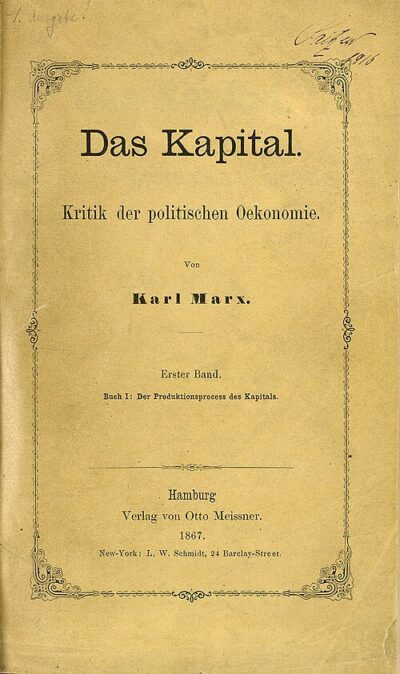
Capital: A Critique of Political Economy is a foundational theoretical text of Karl Marx. It came out in 1867. It is based on The Condition of the Working Class in England in 1844.
All 8 facts, and where they come from
Facts
8 facts · 0 confirmed by two sources · 3 cited · 5 from one source
Where this comes from
Papalocal keeps its own record. It started from these sources; what each one said is kept here as it was copied, so a change on their side never changes this page by itself. Tap one to read its version.
What Wikidata says · copied November 17, 2026 · revision 2548143177
- Described as
- foundational theoretical text of Karl Marx
- Other names
- Capital, Das Kapital
- What it is
- literary work
- Written by
- Karl Marx
- Genre
- essay
- Published
- 1867 · 1 reference
- Language
- German
- Country of origin
- Germany
- Based on
- The Condition of the Working Class in England in 1844 · 1 reference; A Contribution to the Critique of Political Economy · 1 reference
- Wikipedias with a page
- 89
Wikidata item Q58784 (wikidata.org/wiki/Q58784), public domain (CC0). Copied 2026-11-17.
What Wikipedia says · copied November 17, 2026 · revision 1385677862
Capital: A Critique of Political Economy (German: Das Kapital. Kritik der politischen Ökonomie), also known as Das Kapital (German: [das kapiˈtaːl]), is a foundational text in Marxist theory by Karl Marx. His magnum opus, the work is a critical analysis of political economy, meant to reveal the economic patterns underpinning the capitalist mode of production. Capital is divided into three volumes, of which only the first was published during Marx's lifetime, in 1867; the others were completed from his manuscripts and published by his collaborator Friedrich Engels in 1885 and 1894.
The central argument of Capital is that the motivating force of capitalism is in the exploitation of labour, whose unpaid work is the ultimate source of surplus value and profit. Beginning with an analysis of the commodity, Marx argues that the capitalist mode of production is a historically specific system where social relations are mediated by commodity exchange. He posits a labour theory of value, contending that the economic value of a commodity is determined by the socially necessary labour time required for its production. Under this system, the worker's capacity to labour (their labour power) is sold as a commodity, but its use-value—the ability to create new value—is greater than its exchange-value (the wage), allowing the capitalist to extract surplus value. This process drives capital accumulation, which in turn fosters technological change, the creation of a reserve army of labour, and a long-term tendency of the rate of profit to fall, leading to economic crises and intensifying class conflict.
In developing his critique, Marx synthesised and critiqued three main intellectual traditions: the classical political economy of thinkers like Adam Smith and David Ricardo, the German idealist philosophy of Georg Wilhelm Friedrich Hegel, and French socialist thought. His dialectical method aimed to uncover the internal contradictions and historical transience of capitalism. A key theme is commodity fetishism, the process by which the social relations of production are obscured and appear as objective, natural relations between things. Volume I focuses on the production process, Volume II on the circulation of capital, and Volume III on the process as a whole, examining the distribution of surplus value into profit, interest, and rent.
Capital is one of the most influential works of social science ever written. Its analysis has been foundational to the international labour movement, socialist and communist political parties, and a wide range of academic disciplines, including sociology, political science, and philosophy. It remains central to Marxian economics and has been highly influential in Western Marxism, critical theory, and cultural studies. The work has been subject to extensive debate and criticism since its publication, particularly concerning its labour theory of value, its predictions about the future of capitalism, and its association with 20th-century communist states.
From the Wikipedia article “Das Kapital” (en.wikipedia.org/wiki/Das_Kapital), by its contributors, under CC BY-SA 4.0 (creativecommons.org/licenses/by-sa/4.0/). Copied 2026-11-17; not changed.
Confirmed Two sources agree. Cited One source, and it names where it got it. One source One source, without a reference of its own. Sources disagree The sources disagree. We show the best-supported value and keep theirs below.
Picture: Zentralbibliothek Zürich, via Wikimedia Commons · Public domain