
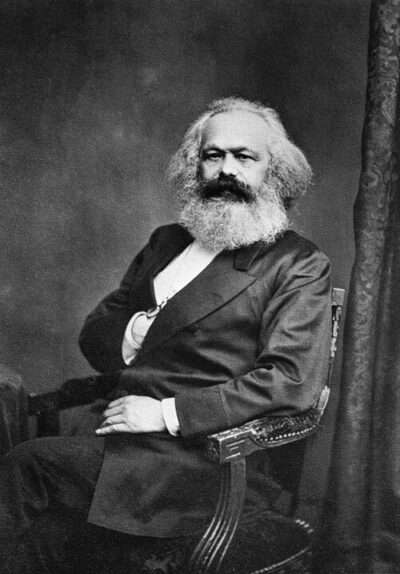
Karl Marx
Karl Marx was a German-born philosopher. Born May 5, 1818, in Trier. Died March 14, 1883, in London. Known for Economic and Philosophic Manuscripts of 1844, Capital: A Critique of Political Economy and The German Ideology. Educated at University of Bonn and University of Jena. Awards include Fellow of the Royal Society of Arts.
Facts
56 facts · 2 confirmed by two sources · 32 cited · 21 from one source · 1 where the sources disagree
What’s different
- Buried in: we show Tomb of Karl Marx (Sources disagree). Wikidata also lists Highgate Cemetery
Where this comes from
Papalocal keeps its own record. It started from these sources; what each one said is kept here as it was copied, so a change on their side never changes this page by itself. Tap one to read its version.
What Wikidata says · copied November 16, 2026 · revision 2568606070
- Described as
- German-born philosopher (1818–1883)
- Other names
- Marx, Karl Heinrich Marx, Karl H. Marx
- Born
- May 5, 1818 · 21 references
- Died
- March 14, 1883 · 19 references
- Born in
- Trier · 9 references
- Died in
- London · 6 references
- Buried in
- Tomb of Karl Marx · 1 reference; Highgate Cemetery
- Cause of death
- lung disease
- Name at birth
- Karl Heinrich Marx · 1 reference
- Citizen of
- Kingdom of Prussia (–1845) · 2 references; statelessness (1845–)
- Occupation
- economist · 4 references; journalist · 2 references; historian · 1 reference; philosopher · 3 references; sociologist · 2 references; revolutionary · 1 reference; poet · 1 reference; politician · 2 references
- Political party
- Communist League
- Worked for
- Neue Rheinische Zeitung; Rheinische Zeitung
- Education
- University of Bonn (1835–1836) · 5 references; University of Jena · 2 references; Humboldt-Universität zu Berlin (1836–) · 4 references; Gymnasium Friedrich Wilhelm in Trier (1830–) · 1 reference
- Member of
- International Workingmen's Association (1864–1872) · 2 references; Marx siblings; Karl Marx and Friedrich Engels
- Known for
- Economic and Philosophic Manuscripts of 1844; Capital: A Critique of Political Economy; The German Ideology; The Communist Manifesto
- Awards
- Fellow of the Royal Society of Arts
- Field
- political economics; sociology; philosophy
- Spouse
- Jenny von Westphalen (1843–1881) · 4 references
- Children
- Eleanor Marx · 3 references; Jenny Longuet · 3 references; Laura Marx · 3 references; Edgar Marx · 2 references; Frederick Demuth; Heinrich Edward Guy Marx · 1 reference; Jenny Evelin Francis Marx · 1 reference
- Father
- Heinrich Marx · 4 references
- Mother
- Henriette Presburg · 2 references
- Siblings
- Emilie Conradi · 1 reference; Louise Juta · 1 reference; Mauritz David Marx; Sophia Marx · 1 reference
- Religion
- atheism · 1 reference; antitheism · 1 reference
- Lived in
- London (1849–1883) · 2 references; Trier; Berlin (1836–) · 1 reference; Paris (1843–) · 3 references; The Swan (1845–1848) · 1 reference
- Wikipedias with a page
- 314
Wikidata item Q9061 (wikidata.org/wiki/Q9061), public domain (CC0). Copied November 16, 2026.
What Wikipedia says · copied November 16, 2026 · revision 1385588109
Karl Marx (German: [ˈkaʁl ˈmaʁks]; 5 May 1818 – 14 March 1883) was a German philosopher, social and political theorist, journalist, and revolutionary socialist. He developed the theory of historical materialism to analyse societal development, focusing on class struggle under capitalism and predicting the system's ultimate replacement by communism. Marx co-authored The Communist Manifesto (1848) with Friedrich Engels, and undertook a critique of political economy in his magnum opus, Das Kapital (1867–1894). His ideas and their later development, collectively known as Marxism, have had enormous influence on intellectual, political, and social history, and have inspired revolutionary movements in many countries.
Born in Trier in the Kingdom of Prussia, Marx earned a doctoral degree in philosophy from the University of Jena in 1841. He became involved in radical journalism and was influenced by the philosophy of Georg Wilhelm Friedrich Hegel and the Young Hegelians, whose ideas he critiqued in works such as The German Ideology. In Paris, Marx wrote his Economic and Philosophic Manuscripts of 1844 and began a close collaboration with Engels. After moving to Brussels, they were active in the Communist League, and in 1848 wrote The Communist Manifesto, which lays out a programme for revolution. Expelled from Germany after the Revolutions of 1848, Marx moved to London, where he wrote his Grundrisse notebooks and the three volumes of Das Kapital. He became a leading figure in the International Workingmen's Association (First International), in which he battled the influence of anarchists led by Mikhail Bakunin and celebrated the Paris Commune of 1871. In his late studies and his Critique of the Gotha Programme (1875), Marx theorized on the transition to a communist society. He died in 1883 and was buried in Highgate Cemetery.
Marx's critiques of history, society and political economy hold that human societies develop through class conflict. In the capitalist mode of production, this manifests itself in the conflict between the bourgeoisie, the ruling class that controls the means of production, and the proletariat, the working class that enables these means by selling their labour power for wages. Employing his dialectical approach, Marx observed that capital accumulation produced internal contradictions like previous socioeconomic systems, and predicted that these tensions would lead to its self-destruction. For Marx, the exploitative, alienating, and crisis-prone nature of capitalism would eventuate the working class's development of class consciousness, leading to their conquest of political power and establishment of a classless, stateless, moneyless society constituted by a free association of producers. Marx actively pressed for its realisation, advocating for organised proletarian revolutionary action to achieve human emancipation from economic and social domination.
Marx has been described as one of the most influential figures of the modern era, and his work has been both widely lauded and widely criticised. Marxism has exerted major influence on socialist thought and political movements, with Marxist schools of thought such as Marxism–Leninism and its offshoots becoming the guiding ideologies of revolutions that took power in many countries during the 20th century, forming communist states. Marx's work in economics has had a strong influence on modern heterodox theories of labour and capital, and he is often cited as one of the principal architects of modern sociology.
- Born, in its opening lines
- May 5, 1818
- Died, in its opening lines
- March 14, 1883
From the Wikipedia article “Karl Marx” (en.wikipedia.org/wiki/Karl_Marx), by its contributors, under CC BY-SA 4.0 (creativecommons.org/licenses/by-sa/4.0/). Copied November 16, 2026; not changed.
Confirmed Two sources agree. Cited One source, and it names where it got it. One source One source, without a reference of its own. Sources disagree The sources disagree. We show the best-supported value and keep theirs below.
