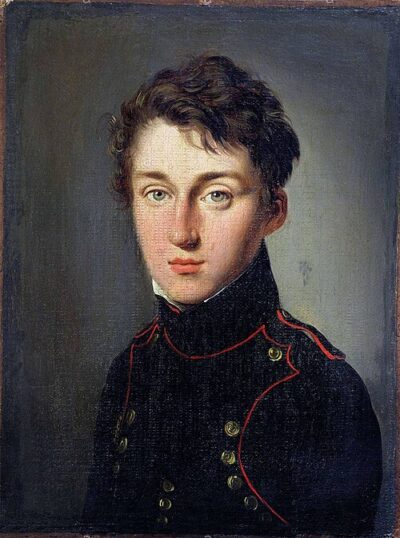
Carnot's theorem
Carnot's theorem is an in thermodynamics, the principle that any heat engine operating between the same two thermal reservoirs cannot have an efficiency greater than a reversible heat engine operating between the same reservoirs.
All 2 facts, and where they come from
Facts
2 facts · 0 confirmed by two sources · 0 cited · 2 from one source
Where this comes from
Papalocal keeps its own record. It started from these sources; what each one said is kept here as it was copied, so a change on their side never changes this page by itself. Tap one to read its version.
What Wikidata says · copied November 17, 2026 · revision 2537025899
- Described as
- in thermodynamics, the principle that any heat engine operating between the same two thermal reservoirs cannot have an efficiency greater than a reversible heat engine operating between the same reservoirs
- Other names
- Carnot's rule
- What it is
- theorem
- Named after
- Nicolas Carnot
- Wikipedias with a page
- 22
Wikidata item Q2347139 (wikidata.org/wiki/Q2347139), public domain (CC0). Copied 2026-11-17.
What Wikipedia says · copied November 17, 2026 · revision 1370964129
Carnot's theorem (English: kar-NOH, French: [kaʁno]), also called Carnot's rule or Carnot's law, is a principle of thermodynamics developed by Nicolas Léonard Sadi Carnot in 1824 that specifies limits on the maximum efficiency that any heat engine can obtain.
Carnot's theorem states that all heat engines operating between the same two thermal or heat reservoirs cannot have efficiencies greater than a reversible heat engine operating between the same reservoirs. A corollary of this theorem is that every reversible heat engine operating between a pair of heat reservoirs is equally efficient, regardless of the working substance employed or the operation details. Since a Carnot heat engine is also a reversible engine, the efficiency of all the reversible heat engines is determined as the efficiency of the Carnot heat engine that depends solely on the temperatures of its hot and cold reservoirs.
The maximum efficiency (i.e., the Carnot heat engine efficiency) of a heat engine operating between hot and cold reservoirs, denoted as H and C respectively, is the ratio of the temperature difference between the reservoirs to the hot reservoir temperature, expressed in the equationηmax=TH−TCTH,
where TH and TC are the absolute temperatures of the hot and cold reservoirs, respectively, and the efficiency η is the ratio of the work done by the engine (to the surroundings) to the heat drawn out of the hot reservoir (to the engine).
ηmax is greater than zero if and only if there is a temperature difference between the two thermal reservoirs. Since ηmax is the upper limit of all reversible and irreversible heat engine efficiencies, it is concluded that work from a heat engine can be produced if and only if there is a temperature difference between two thermal reservoirs connecting to the engine.
Carnot's theorem is a consequence of the second law of thermodynamics. Historically, it was based on contemporary caloric theory, and preceded the establishment of the second law.
From the Wikipedia article “Carnot's theorem (thermodynamics)” (en.wikipedia.org/wiki/Carnot's_theorem_(thermodynamics)), by its contributors, under CC BY-SA 4.0 (creativecommons.org/licenses/by-sa/4.0/). Copied 2026-11-17; not changed.
Confirmed Two sources agree. Cited One source, and it names where it got it. One source One source, without a reference of its own. Sources disagree The sources disagree. We show the best-supported value and keep theirs below.