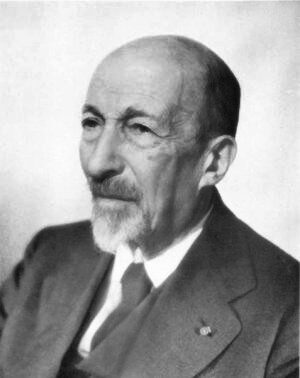
Cartan–Hadamard theorem
Cartan–Hadamard theorem is an On the structure of complete Riemannian manifolds of non-positive sectional curvature.
All 3 facts, and where they come from
Facts
3 facts · 0 confirmed by two sources · 0 cited · 3 from one source
Where this comes from
Papalocal keeps its own record. It started from these sources; what each one said is kept here as it was copied, so a change on their side never changes this page by itself. Tap one to read its version.
What Wikidata says · copied November 17, 2026 · revision 2524843842
- Described as
- On the structure of complete Riemannian manifolds of non-positive sectional curvature
- What it is
- theorem
- Named after
- Élie Cartan; Jacques Hadamard
- Wikipedias with a page
- 8
Wikidata item Q5047048 (wikidata.org/wiki/Q5047048), public domain (CC0). Copied 2026-11-17.
What Wikipedia says · copied November 17, 2026 · revision 1350939441
In mathematics, the Cartan–Hadamard theorem is a statement in Riemannian geometry concerning the structure of complete Riemannian manifolds of non-positive sectional curvature. The theorem states that the universal cover of such a manifold is diffeomorphic to a Euclidean space via the exponential map at any point. It was first proved by Hans Carl Friedrich von Mangoldt for surfaces in 1881, and independently by Jacques Hadamard in 1898. Élie Cartan generalized the theorem to Riemannian manifolds in 1928 (Helgason 1978; do Carmo 1992; Kobayashi & Nomizu 1969). The theorem was further generalized to a wide class of metric spaces by Mikhail Gromov in 1987; detailed proofs were published by Ballmann (1990) for metric spaces of non-positive curvature and by Alexander & Bishop (1990) for general locally convex metric spaces.
From the Wikipedia article “Cartan–Hadamard theorem” (en.wikipedia.org/wiki/Cartan–Hadamard_theorem), by its contributors, under CC BY-SA 4.0 (creativecommons.org/licenses/by-sa/4.0/). Copied 2026-11-17; not changed.
Confirmed Two sources agree. Cited One source, and it names where it got it. One source One source, without a reference of its own. Sources disagree The sources disagree. We show the best-supported value and keep theirs below.