
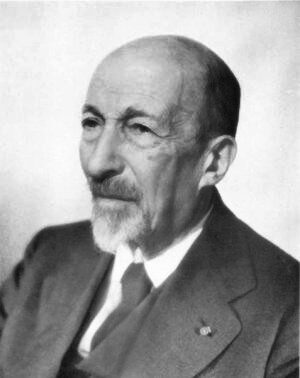
Jacques Hadamard
Jacques Hadamard was a French mathematician. Born December 8, 1865, in Versailles. Died October 17, 1963, in Paris. Positions held include chairperson (1906–1907). Known for Œuvres de Jacques Hadamard, Hadamard matrix and Cauchy–Hadamard theorem. Educated at École Normale Supérieure and Lycée Louis-le-Grand. Awards include CNRS Gold medal, Feltrinelli Prize and Poncelet Prize.
Facts
62 facts · 2 confirmed by two sources · 30 cited · 30 from one source
Where this comes from
Papalocal keeps its own record. It started from these sources; what each one said is kept here as it was copied, so a change on their side never changes this page by itself. Tap one to read its version.
What Wikidata says · copied November 16, 2026 · revision 2567356037
- Described as
- French mathematician (1865–1963)
- Other names
- Jacques Salomon Hadamard
- Born
- December 8, 1865 · 10 references
- Died
- October 17, 1963 · 11 references
- Born in
- Versailles · 3 references
- Died in
- Paris · 3 references
- Buried in
- Père Lachaise Cemetery · 3 references
- Name at birth
- Jacques Salomon Hadamard · 1 reference
- Citizen of
- France
- Occupation
- mathematician · 1 reference; professor · 1 reference; researcher · 1 reference; university teacher · 1 reference
- Positions held
- chairperson (1906–1907) · 1 reference
- Worked for
- Collège de France (1897–1937) · 2 references; Columbia University (1940–1944) · 1 reference; École polytechnique (1912–1940) · 1 reference; Lycée Buffon (1890–1893) · 1 reference; University of Paris (1897–1912) · 1 reference; Lycée Saint-Louis (1889–1890) · 1 reference; University of Bordeaux (1893–1897) · 1 reference; École Centrale Paris (1920–1933) · 1 reference
- Education
- École Normale Supérieure (1885–1888) · 1 reference; Lycée Louis-le-Grand (1876–1884) · 2 references; Lycée Charlemagne (–1876) · 2 references; University of Paris (–1892) · 1 reference
- Member of
- Royal Society of London (1932–); French Academy of Sciences; Academy of Sciences of the USSR; Royal Swedish Academy of Sciences; Polish Academy of Sciences; American Academy of Arts and Sciences; Accademia Nazionale dei Lincei (1918–) · 1 reference; Russian Academy of Sciences; Royal Netherlands Academy of Arts and Sciences; National Academy of Sciences (1926–)
- Known for
- Œuvres de Jacques Hadamard; Hadamard matrix; Cauchy–Hadamard theorem; Hadamard product; Hadamard transform; Hadamard's inequality; Ostrowski–Hadamard gap theorem; Hadamard factorization theorem; Hermite–Hadamard inequality; Cartan–Hadamard theorem
- Awards
- CNRS Gold medal (1956) · 2 references; Feltrinelli Prize (1951) · 1 reference; Poncelet Prize (1898) · 1 reference; Grand Cross of the Legion of Honour (1954) · 1 reference; honorary doctor of the Hebrew University of Jerusalem (1957) · 1 reference; Grand prix des sciences mathématiques (1892) · 1 reference; Concours général (1883) · 1 reference; Silliman Memorial Lectures (1919) · 1 reference; Foreign Member of the Royal Society (1932) · 1 reference; Estrade-Delcros award (1908) · 1 reference; Petit d'Ormoy, Carriere, Thebault Award (1903) · 1 reference
- Field
- partial differential equation; number theory; mathematics · 1 reference; mechanics · 1 reference; theoretical mechanics · 1 reference; analytic function · 1 reference
- Father
- Amédée Hadamard
- Wikipedias with a page
- 53
Wikidata item Q164425 (wikidata.org/wiki/Q164425), public domain (CC0). Copied November 16, 2026.
What Wikipedia says · copied November 16, 2026 · revision 1373813734
Jacques Salomon Hadamard (French: [adamaʁ]; 8 December 1865 – 17 October 1963) was a French mathematician who made major contributions in complex analysis, number theory, differential geometry, and partial differential equations.
- Born, in its opening lines
- December 8, 1865
- Died, in its opening lines
- October 17, 1963
From the Wikipedia article “Jacques Hadamard” (en.wikipedia.org/wiki/Jacques_Hadamard), by its contributors, under CC BY-SA 4.0 (creativecommons.org/licenses/by-sa/4.0/). Copied November 16, 2026; not changed.
Confirmed Two sources agree. Cited One source, and it names where it got it. One source One source, without a reference of its own. Sources disagree The sources disagree. We show the best-supported value and keep theirs below.
