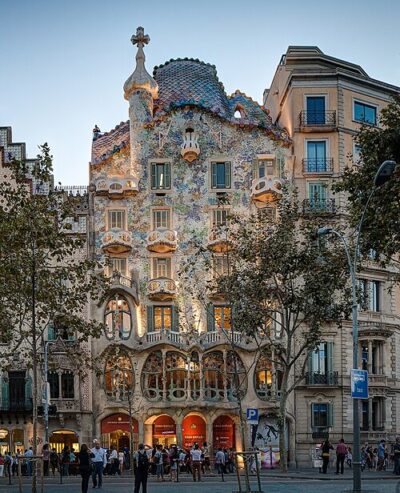
Casa Batlló
Casa Batlló is a modernist building in Barcelona. It came out in 1877.
- Came out
- 1877
All 7 facts, and where they come from
Facts
7 facts · 0 confirmed by two sources · 2 cited · 5 from one source
Where this comes from
Papalocal keeps its own record. It started from these sources; what each one said is kept here as it was copied, so a change on their side never changes this page by itself. Tap one to read its version.
What Wikidata says · copied November 17, 2026 · revision 2564387979
- Described as
- modernist building in Barcelona
- What it is
- multifamily residential · 1 reference; residential building (1904–1906) · 1 reference
- Came out
- 1877
- Located in
- Dreta de l'Eixample
- Country
- Spain · 1 reference
- Named after
- Josep Batlló i Casanovas
- Official website
- https://www.casabatllo.es/ca/
- Wikipedias with a page
- 51
Wikidata item Q461371 (wikidata.org/wiki/Q461371), public domain (CC0). Copied 2026-11-17.
What Wikipedia says · copied November 17, 2026 · revision 1379160674
Casa Batlló (Catalan pronunciation: [ˈkazə βəˈʎːo] ) is a building in the center of Barcelona, Spain. It was designed by Antoni Gaudí, and is considered one of his masterpieces. A remodel of a previously built house, it was redesigned in 1904 by Gaudí (although the actual construction had not begun at this point) and has been refurbished several times since. Gaudí's assistants Domènec Sugrañes i Gras, Josep Canaleta and Joan Rubió also contributed to the renovation project.
Casa Batlló is located on the Passeig de Gràcia in the Eixample district and forms part of a row of houses known as the Illa de la Discòrdia (or Mansana de la Discòrdia, the "Block of Discord"), so named because it features four striking, and strikingly different, buildings by noted Modernista architects of Barcelona.
Like everything Gaudí designed, Casa Batlló is only identifiable as Modernisme in the broadest sense. The ground floor, in particular, has unusual tracery, irregular oval windows and sculpted stonework with sinuous, squiggly forms. There are few straight lines, and much of the façade is decorated with a colorful mosaic made of broken ceramic tiles (trencadís).
In 2005, Casa Batlló became a UNESCO World Heritage Site.
From the Wikipedia article “Casa Batlló” (en.wikipedia.org/wiki/Casa_Batlló), by its contributors, under CC BY-SA 4.0 (creativecommons.org/licenses/by-sa/4.0/). Copied 2026-11-17; not changed.
Confirmed Two sources agree. Cited One source, and it names where it got it. One source One source, without a reference of its own. Sources disagree The sources disagree. We show the best-supported value and keep theirs below.
Picture: ChristianSchd, via Wikimedia Commons · CC BY-SA 3.0