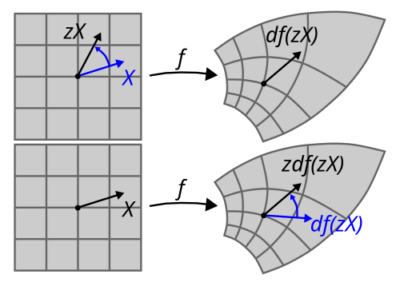
Cauchy–Riemann equations
Cauchy–Riemann equations is a system of linear partial differential equations characterizing holomorphic (complex differentiable) functions.
All 5 facts, and where they come from
Facts
5 facts · 0 confirmed by two sources · 0 cited · 5 from one source
Where this comes from
Papalocal keeps its own record. It started from these sources; what each one said is kept here as it was copied, so a change on their side never changes this page by itself. Tap one to read its version.
What Wikidata says · copied November 17, 2026 · revision 2541695453
- Described as
- system of linear partial differential equations characterizing holomorphic (complex differentiable) functions
- Other names
- d'Alembert–Euler conditions, Cauchy–Riemann conditions
- What it is
- system of differential equations; linear differential equation with constant coefficients; mathematical concept
- Named after
- Augustin-Louis Cauchy; Bernhard Riemann
- Wikipedias with a page
- 35
Wikidata item Q622741 (wikidata.org/wiki/Q622741), public domain (CC0). Copied 2026-11-17.
What Wikipedia says · copied November 17, 2026 · revision 1377868925
In mathematics, the Cauchy–Riemann equations are two partial differential equations that characterize differentiability of complex functions. The equations are
and
where u(x, y) and v(x, y) are real bivariate differentiable functions. Typically, u and v are the real and imaginary parts, respectively, of a complex-valued function
f(z)=f(x+iy)=u(x,y)+iv(x,y)
of a complex variable z = x + iy.
If f is complex-differentiable at a complex point z = x + iy, then the partial derivatives of u and v exist and satisfy the Cauchy–Riemann equations at that point. Conversely, if the functions u and v are (real) differentiable at z and satisfy the Cauchy-Riemann equations there, then f is complex-differentiable at z.
In this way, the Cauchy-Riemann equations are closely related to differentiability, which is in turn closely related to analyticity. These close relationships are the starting point of complex analysis.
From the Wikipedia article “Cauchy–Riemann equations” (en.wikipedia.org/wiki/Cauchy–Riemann_equations), by its contributors, under CC BY-SA 4.0 (creativecommons.org/licenses/by-sa/4.0/). Copied 2026-11-17; not changed.
Confirmed Two sources agree. Cited One source, and it names where it got it. One source One source, without a reference of its own. Sources disagree The sources disagree. We show the best-supported value and keep theirs below.
Picture: Cauchy-Riemann.png: Keenan Crane vector version: VectorVoyager, via Wikimedia Commons · CC BY-SA 4.0