
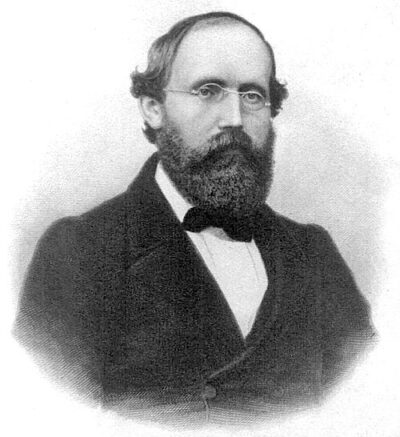
Bernhard Riemann
Bernhard Riemann was a German mathematician. Born September 17, 1826, in Breselenz. Died July 20, 1866, in Selasca. Known for Riemannian geometry, On the Number of Primes Less Than a Given Magnitude and Ueber die Hypothesen, welche der Geometrie zu Grunde liegen. Educated at University of Göttingen and Frederick William University Berlin. Awards include Foreign Member of the Royal Society.
Facts
43 facts · 2 confirmed by two sources · 22 cited · 19 from one source
Where this comes from
Papalocal keeps its own record. It started from these sources; what each one said is kept here as it was copied, so a change on their side never changes this page by itself. Tap one to read its version.
What Wikidata says · copied November 16, 2026 · revision 2563981913
- Described as
- German mathematician (1826–1866)
- Other names
- Georg Friedrich Bernhard Riemann
- Born
- September 17, 1826 · 8 references
- Died
- July 20, 1866 · 7 references
- Born in
- Breselenz · 1 reference
- Died in
- Selasca · 2 references
- Buried in
- cemetery of Biganzolo · 1 reference
- Cause of death
- tuberculosis · 1 reference
- Name at birth
- Georg Friedrich Bernhard Riemann · 1 reference
- Citizen of
- Kingdom of Hanover
- Occupation
- mathematician · 1 reference; physicist; university teacher; professor (1857–) · 1 reference
- Worked for
- University of Göttingen
- Education
- University of Göttingen (1846–1851) · 1 reference; Frederick William University Berlin (1847–1849) · 1 reference; Johanneum Lüneburg (1842–1846) · 1 reference; Kaiser-Wilhelm-Gymnasium (1840–1842) · 1 reference
- Member of
- Royal Society of London (1866–) · 1 reference; Royal Prussian Academy of Sciences (1859–) · 1 reference; Bavarian Academy of Sciences and Humanities (1859–) · 1 reference; Göttingen Academy of Sciences and Humanities in Lower Saxony
- Known for
- Riemannian geometry; On the Number of Primes Less Than a Given Magnitude; Ueber die Hypothesen, welche der Geometrie zu Grunde liegen; Riemann hypothesis; Riemannian manifold; Riemann surface; Riemann zeta function; Riemann sum; Riemann integral; list of things named after Bernhard Riemann
- Awards
- Foreign Member of the Royal Society (1866) · 1 reference
- Field
- differential geometry; mathematics · 1 reference; number theory · 1 reference; mathematical analysis · 1 reference; mathematical physics · 1 reference; Riemann hypothesis · 1 reference
- Spouse
- Elise Koch
- Children
- Ida Riemann · 1 reference
- Father
- Friedrich Bernhard Riemann · 1 reference
- Mother
- Charlotte Ebell · 1 reference
- Religion
- Lutheranism
- Wikipedias with a page
- 111
Wikidata item Q42299 (wikidata.org/wiki/Q42299), public domain (CC0). Copied November 16, 2026.
What Wikipedia says · copied November 16, 2026 · revision 1382173614
Georg Friedrich Bernhard Riemann (; German: [ˈɡeːɔʁk ˈfʁiːdʁɪç ˈbɛʁnhaʁt ˈʁiːman] ; 17 September 1826 – 20 July 1866) was a German mathematician who made profound contributions to analysis, number theory, and differential geometry. In the field of real analysis, he is mostly known for the first rigorous formulation of the integral, the Riemann integral, and his work on Fourier series. His contributions to complex analysis include most notably the introduction of Riemann surfaces, breaking new ground in a natural, geometric treatment of complex analysis. His 1859 paper on the prime-counting function, containing the original statement of the Riemann hypothesis, is regarded as a foundational paper of analytic number theory. Through his pioneering contributions to differential geometry, Riemann laid the foundations of the mathematics of general relativity. He is considered by many to be one of the greatest mathematicians of all time.
- Born, in its opening lines
- September 17, 1826
- Died, in its opening lines
- July 20, 1866
From the Wikipedia article “Bernhard Riemann” (en.wikipedia.org/wiki/Bernhard_Riemann), by its contributors, under CC BY-SA 4.0 (creativecommons.org/licenses/by-sa/4.0/). Copied November 16, 2026; not changed.
Confirmed Two sources agree. Cited One source, and it names where it got it. One source One source, without a reference of its own. Sources disagree The sources disagree. We show the best-supported value and keep theirs below.
