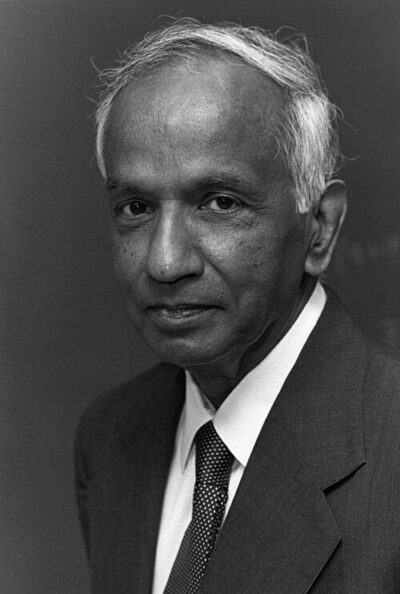
Chandrasekhar's H-function
Chandrasekhar's H-function is a type of mathematical function.
All 3 facts, and where they come from
Facts
3 facts · 0 confirmed by two sources · 0 cited · 3 from one source
Where this comes from
Papalocal keeps its own record. It started from these sources; what each one said is kept here as it was copied, so a change on their side never changes this page by itself. Tap one to read its version.
What Wikidata says · copied November 16, 2026 · revision 2022934641
- Other names
- Ambartsumian's H-function, Busbridge's H-function
- What it is
- type of mathematical function; mathematical concept
- Named after
- Subrahmanyan Chandrasekhar
- Wikipedias with a page
- 3
Wikidata item Q48996454 (wikidata.org/wiki/Q48996454), public domain (CC0). Copied 2026-11-16.
What Wikipedia says · copied November 16, 2026 · revision 1349699837
In atmospheric radiation, Chandrasekhar's H-function appears as the solutions of problems involving scattering, introduced by the Indian American astrophysicist Subrahmanyan Chandrasekhar. The Chandrasekhar's H-function
H
(
μ
){\displaystyle H(\mu )}
defined in the interval
0
≤
μ
≤
1{\displaystyle 0\leq \mu \leq 1}
, satisfies the following nonlinear integral equation
H
(
μ
)
=
1
+
μ
H
(
μ
)∫
0
1
Ψ
(μ
′)
μ
+μ
′H
(μ
′)
d
μ
′{\displaystyle H(\mu )=1+\mu H(\mu )\int _{0}^{1}{\frac {\Psi (\mu ')}{\mu +\mu '}}H(\mu ')\,d\mu '}
where the characteristic function
Ψ
(
μ
){\displaystyle \Psi (\mu )}
is an even polynomial in
μ
{\displaystyle \mu }
satisfying the following condition
∫
0
1
Ψ
(
μ
)d
μ
≤1
2{\displaystyle \int _{0}^{1}\Psi (\mu )\,d\mu \leq {\frac {1}{2}}}
.
If the equality is satisfied in the above condition, it is called conservative case, otherwise non-conservative. Albedo is given byω
o
=
2
Ψ
(
μ
)
=constant
{\displaystyle \omega _{o}=2\Psi (\mu )={\text{constant}}}
. An alternate form which would be more useful in calculating the H function numerically by iteration was derived by Chandrasekhar as,
1
H
(
μ
)=
[
1
−
2∫
0
1
Ψ
(
μ
)d
μ]
1
/
2
+
∫
0
1
μ
′Ψ
(μ
′)
μ
+μ
′H
(μ
′)
d
μ
′{\displaystyle {\frac {1}{H(\mu )}}=\left[1-2\int _{0}^{1}\Psi (\mu )\,d\mu \right]^{1/2}+\int _{0}^{1}{\frac {\mu '\Psi (\mu ')}{\mu +\mu '}}H(\mu ')\,d\mu '}
.
In conservative case, the above equation reduces to1
H
(
μ
)=
∫
0
1
μ
′Ψ
(μ
′)
μ
+μ
′H
(μ
′)
dμ
′{\displaystyle {\frac {1}{H(\mu )}}=\int _{0}^{1}{\frac {\mu '\Psi (\mu ')}{\mu +\mu '}}H(\mu ')d\mu '}
.
From the Wikipedia article “Chandrasekhar's H-function” (en.wikipedia.org/wiki/Chandrasekhar's_H-function), by its contributors, under CC BY-SA 4.0 (creativecommons.org/licenses/by-sa/4.0/). Copied 2026-11-16; not changed.
Confirmed Two sources agree. Cited One source, and it names where it got it. One source One source, without a reference of its own. Sources disagree The sources disagree. We show the best-supported value and keep theirs below.