
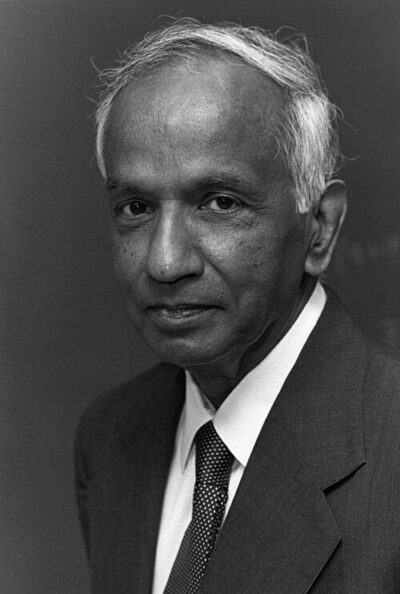
Subrahmanyan Chandrasekhar
Subrahmanyan Chandrasekhar was an Indian-American astrophysicist. Born October 19, 1910, in Lahore. Died August 21, 1995, in Chicago. Known for Chandrasekhar limit, Chandrasekhar number and Schönberg–Chandrasekhar limit. Educated at Trinity College and Presidency College. Awards include Fellow of the Royal Society, Copley Medal and Royal Medal.
Facts
61 facts · 2 confirmed by two sources · 27 cited · 32 from one source
Where this comes from
Papalocal keeps its own record. It started from these sources; what each one said is kept here as it was copied, so a change on their side never changes this page by itself. Tap one to read its version.
What Wikidata says · copied November 13, 2026 · revision 2567377581
- Described as
- Indian-American astrophysicist
- Other names
- Subramanyan Chandrasekhar, Subrahmanya Chandrasekhar, Chandrasekhar Subrahmanyan
- Born
- October 19, 1910 · 8 references
- Died
- August 21, 1995 · 8 references
- Born in
- Lahore · 1 reference
- Died in
- Chicago · 2 references
- Cause of death
- cardiac arrest · 2 references
- Citizen of
- United States (1953–); India (–1953); British Raj (–1947)
- Occupation
- mathematician; physicist; astronomer; astrophysicist · 2 references; university teacher · 1 reference
- Worked for
- University of Chicago (1942–1985) · 1 reference; Trinity College (1933–1937) · 1 reference; Yerkes Observatory (1937–1942) · 1 reference
- Education
- Trinity College (1930–1933) · 1 reference; Presidency College (1921–1930) · 1 reference; University of Cambridge (–1933) · 1 reference; Hindu Higher Secondary School
- Member of
- Royal Society of London (1944–); Royal Swedish Academy of Sciences; American Academy of Arts and Sciences; National Academy of Sciences (1955–); Indian National Science Academy; American Astronomical Society · 1 reference; Bavarian Academy of Sciences and Humanities; The World Academy of Sciences · 1 reference; American Philosophical Society (1945–); Accademia Nazionale dei Lincei (1993–) · 1 reference
- Known for
- Chandrasekhar limit; Chandrasekhar number; Schönberg–Chandrasekhar limit; Chandrasekhar–Wentzel lemma; Chandrasekhar's X- and Y-function; Batchelor–Chandrasekhar equation; Chandrasekhar's H-function; Chandrasekhar–Fermi method; Chandrasekhar–Page equations; Chandrasekhar virial equations
- Awards
- Fellow of the Royal Society (1944) · 1 reference; Copley Medal (1984) · 1 reference; Royal Medal (1962) · 1 reference; Nobel Prize in Physics (1983) · 2 references; Henry Draper Medal (1971) · 2 references; Henry Norris Russell Lectureship (1949) · 1 reference; Gold Medal of the Royal Astronomical Society (1953) · 1 reference; National Medal of Science (1966) · 1 reference; Karl Schwarzschild Medal (1986) · 2 references; Bruce Medal (1952) · 2 references; Dr. Tomalla Prize (1981) · 1 reference; Josiah Willard Gibbs Lectureship (1946) · 1 reference; Rumford Prize (1957) · 2 references; Padma Vibhushan in Science & Engineering (1968) · 1 reference; Srinivasa Ramanujan Medal (1962) · 1 reference
- Field
- astrophysics · 1 reference; physics · 1 reference; mathematics · 1 reference
- Spouse
- Lalitha Doraiswamy · 1 reference
- Father
- CS Ayyar · 1 reference
- Religion
- atheism
- Wikipedias with a page
- 93
Wikidata item Q148109 (wikidata.org/wiki/Q148109), public domain (CC0). Copied November 13, 2026.
What Wikipedia says · copied November 13, 2026 · revision 1384919971
Subrahmanyan Chandrasekhar (19 October 1910 – 21 August 1995) was an Indian-American astrophysicist. He shared the 1983 Nobel Prize in Physics "for his theoretical studies of the physical processes of importance to the structure and evolution of the stars." His mathematical treatment of stellar evolution yielded many of the current theoretical models of the later evolutionary stages of massive stars. The Chandrasekhar limit describes the maximum mass of a white dwarf (1.44 solar masses). Above it, a stellar remnant will collapse to form a neutron star or black hole. Many concepts, institutions and inventions, including the Chandra X-Ray Observatory, are named after him.
Born in the late British Raj, Chandrasekhar worked on a wide variety of problems in physics during his lifetime, contributing to the contemporary understanding of stellar structure, white dwarfs, stellar dynamics, stochastic process, radiative transfer, the quantum theory of the hydrogen anion, hydrodynamic and hydromagnetic stability, turbulence, equilibrium and the stability of ellipsoidal figures of equilibrium, general relativity, mathematical theory of black holes and theory of colliding gravitational waves. At the University of Cambridge, he developed a theoretical model explaining the structure of white dwarf stars that took into account the relativistic variation of mass with the velocities of electrons that comprise their degenerate matter. Chandrasekhar revised the models of stellar dynamics first outlined by Jan Oort and others by considering the effects of fluctuating gravitational fields within the Milky Way on stars rotating about the galactic center. His solution to this complex dynamical problem involved a set of twenty partial differential equations, describing a new quantity he termed "dynamical friction", which has the dual effects of decelerating the star and helping to stabilize clusters of stars. Chandrasekhar extended this analysis to the interstellar medium, showing that clouds of galactic gas and dust are distributed very unevenly.
Chandrasekhar studied at Presidency College, Madras (now Chennai) and the University of Cambridge. A longtime professor at the University of Chicago, he did some of his studies at the Yerkes Observatory, and served as editor of The Astrophysical Journal from 1952 to 1971. He was on the faculty at Chicago from 1937 until his death in 1995 at the age of 84, and was the Morton D. Hull Distinguished Service Professor of Theoretical Astrophysics.
- Born, in its opening lines
- October 19, 1910
- Died, in its opening lines
- August 21, 1995
From the Wikipedia article “Subrahmanyan Chandrasekhar” (en.wikipedia.org/wiki/Subrahmanyan_Chandrasekhar), by its contributors, under CC BY-SA 4.0 (creativecommons.org/licenses/by-sa/4.0/). Copied November 13, 2026; not changed.
Confirmed Two sources agree. Cited One source, and it names where it got it. One source One source, without a reference of its own. Sources disagree The sources disagree. We show the best-supported value and keep theirs below.
