chemical weapon
Chemical weapon is a device that uses chemicals to harm or kill people.
All 1 facts, and where they come from
Facts
1 facts · 0 confirmed by two sources · 0 cited · 1 from one source
Where this comes from
Papalocal keeps its own record. It started from these sources; what each one said is kept here as it was copied, so a change on their side never changes this page by itself. Tap one to read its version.
What Wikidata says · copied November 17, 2026 · revision 2568786355
- Described as
- device that uses chemicals to harm or kill people
- Other names
- CW
- What it is
- weapon type
- Wikipedias with a page
- 81
Wikidata item Q3639228 (wikidata.org/wiki/Q3639228), public domain (CC0). Copied 2026-11-17.
What Wikipedia says · copied November 17, 2026 · revision 1374470430
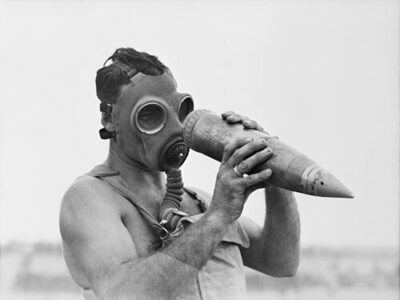
A chemical weapon (CW) is a specialized munition that uses chemicals formulated to inflict death or harm on humans. According to the Organisation for the Prohibition of Chemical Weapons (OPCW), this can be any chemical compound intended as a weapon "or its precursor that can cause death, injury, temporary incapacitation or sensory irritation through its chemical action. Munitions or other delivery devices designed to deliver chemical weapons, whether filled or unfilled, are also considered weapons themselves."
Lethal chemical weapons include nerve agents (tabun, sarin, soman, VX/VR, and Novichok) and blister agents (primarily mustard gas). Non-lethal chemical weapons include tear gases like CS gas and pepper spray and incapacitating agents like 3-Q/BZ. Chemical weapons are typically highly volatile, while some like VX are persistent. They may be unitary or binary, combining from precursors in situ. Toxin weapons, as complex biologically produced chemicals, blur the line with biological weapons.
Lethal chemical weapons are considered weapons of mass destruction, alongside biological weapons, radiological weapons, and nuclear weapons. Under the OPCW definition, toxic agents are not chemical weapons when used for another of their properties e.g. the herbicide Agent Orange or the incendiary white phosphorus.
The history of chemical warfare dates from antiquity. Chemical weapons were first used on a large scale by most major powers in World War I, employing mustard gas, the choking agents phosgene gas and chlorine, and others, causing lung scarring, blindness, and death. During World War II, Nazi Germany used a commercial hydrogen cyanide blood agent trade-named Zyklon B to commit industrialised genocide against Jews and other populations in gas chambers. The Holocaust resulted in the largest death toll to chemical weapons in history. The Empire of Japan also used chemical warfare in China during the Second Sino-Japanese War, including mustard gas and lewisite.
Nazi Germany discovered nerve agents during the war, but did not use them for fear of Allied retaliation. In the Cold War, many countries stockpiled chemical weapons. The Soviet and United States chemical weapons programs became the first and second largest in world history, focusing on sarin, VX/VR, and mustard, primarily for battlefield use in Europe. Chemical weapons were repeatedly used in the Iran–Iraq War and Syrian civil war.
At the end of the Cold War, the 1993 Chemical Weapons Convention sought a legally binding, worldwide ban on the production, stockpiling, and use of chemical weapons and their precursors. Large-scale stockpile destruction efforts followed, with the US eliminating its arsenal by 2023. As of 2025 the treaty has 193 state parties; Syria and Russia are widely believed to have violated its prohibitions on stockpiling and use while Israel and North Korea remain non-parties. Small research quantities are treaty-permitted as part of CBRN defense.
From the Wikipedia article “Chemical weapon” (en.wikipedia.org/wiki/Chemical_weapon), by its contributors, under CC BY-SA 4.0 (creativecommons.org/licenses/by-sa/4.0/). Copied 2026-11-17; not changed.
Confirmed Two sources agree. Cited One source, and it names where it got it. One source One source, without a reference of its own. Sources disagree The sources disagree. We show the best-supported value and keep theirs below.
Picture: not stated, via Wikimedia Commons · Public domain