
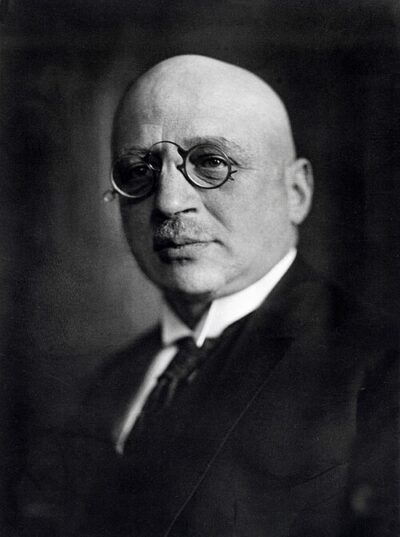
Fritz Haber
Fritz Haber was a German chemist and receiver of the Nobel prize. Born December 9, 1868, in Wrocław. Died January 29, 1934, in Basel. Positions held include Geheimrat and director (1911–). Known for Haber-Bosch process and chemical weapon. Educated at ETH Zurich and Technische Universität Berlin. Awards include Nobel Prize in Chemistry, Harnack medal and Wilhelm Exner Medal.
Facts
52 facts · 2 confirmed by two sources · 17 cited · 33 from one source
Where this comes from
Papalocal keeps its own record. It started from these sources; what each one said is kept here as it was copied, so a change on their side never changes this page by itself. Tap one to read its version.
What Wikidata says · copied November 16, 2026 · revision 2569028481
- Described as
- German chemist and receiver of the Nobel prize (1868–1934)
- Born
- December 9, 1868 · 11 references
- Died
- January 29, 1934 · 12 references
- Born in
- Wrocław · 1 reference
- Died in
- Basel · 3 references
- Buried in
- Friedhof am Hörnli · 1 reference
- Cause of death
- myocardial infarction
- Citizen of
- Weimar Republic; Kingdom of Prussia
- Occupation
- chemist · 1 reference; physicist; engineer; university teacher
- Positions held
- Geheimrat; director (1911–)
- Worked for
- Humboldt-Universität zu Berlin; ETH Zurich; TH Karlsruhe (1894–) · 1 reference; Fritz Haber Institute of the MPG (1911–1933) · 1 reference
- Education
- ETH Zurich; Technische Universität Berlin (1886–1891); Heidelberg University (1886–1891); Humboldt-Universität zu Berlin (1886–1891); Johanneum Breslau; Elisabeth-Gymnasium
- Member of
- German Academy of Sciences Leopoldina (1926–); National Academy of Sciences (1932–) · 2 references; Academy of Sciences of the USSR (1932–) · 1 reference; Bavarian Academy of Sciences and Humanities; American Academy of Arts and Sciences; Göttingen Academy of Sciences and Humanities in Lower Saxony
- Known for
- Haber-Bosch process · 1 reference; chemical weapon · 1 reference
- Awards
- Nobel Prize in Chemistry (1918) · 2 references; Harnack medal (1926) · 1 reference; Wilhelm Exner Medal (1929) · 1 reference; Rumford Medal (1932) · 2 references; National Inventors Hall of Fame (2006) · 1 reference; Liebig Medal (1914) · 1 reference; Bunsen Medal (1918) · 1 reference; honorary member of the Physics Association (Frankfurt am Main, Germany) (1910)
- Field
- physical chemistry; chemistry · 1 reference
- Spouse
- Clara Immerwahr (1901–1915) · 1 reference; Charlotte Haber (1917–1927) · 1 reference
- Children
- Hermann Haber; Ludwig F. Haber · 1 reference
- Father
- Siegfried Haber
- Religion
- Lutheranism; Judaism · 1 reference
- Lived in
- Cambridge (1933–); Karlsruhe (1894–1902); United States (1902)
- Wikipedias with a page
- 95
Wikidata item Q57075 (wikidata.org/wiki/Q57075), public domain (CC0). Copied November 16, 2026.
What Wikipedia says · copied November 16, 2026 · revision 1382848317
Fritz Jakob Haber (German: [ˈfʁɪt͡s ˈhaːbɐ] ; 9 December 1868 – 29 January 1934) was a German chemist who received the Nobel Prize in Chemistry in 1918 for his invention of the Haber process, a method used in industry to synthesize ammonia from nitrogen gas and hydrogen gas. This invention is important for the large-scale synthesis of fertilizers and explosives. It is estimated that a third of annual global food production uses ammonia from the Haber–Bosch process, and that this food supports nearly half the world's population. For this work, Haber has been called one of the most important scientists and industrial chemists in human history. Haber also, along with Max Born, proposed the Born–Haber cycle as a method for evaluating the lattice energy of an ionic solid.
Haber, a known German nationalist, is also considered the "father of chemical warfare" for his years of pioneering work developing and weaponizing chlorine and other poisonous gases during World War I. He first proposed the use of the heavier-than-air chlorine gas as a weapon to break the trench deadlock during the Second Battle of Ypres. His work was later used, without his direct involvement, to develop the Zyklon B pesticide used for the killing of more than 1 million Jews in gas chambers in the greater context of the Holocaust.
Following the Nazis' rise to power in 1933, Haber resigned from his position. Already in poor health, he spent time in various countries before Chaim Weizmann invited him to become the director of the Sieff Research Institute (now the Weizmann Institute) in Rehovot, Mandatory Palestine. He accepted the offer but died of heart failure mid-journey in a hotel in Basel, Switzerland on 29 January 1934, aged 65.
- Born, in its opening lines
- December 9, 1868
- Died, in its opening lines
- January 29, 1934
From the Wikipedia article “Fritz Haber” (en.wikipedia.org/wiki/Fritz_Haber), by its contributors, under CC BY-SA 4.0 (creativecommons.org/licenses/by-sa/4.0/). Copied November 16, 2026; not changed.
Confirmed Two sources agree. Cited One source, and it names where it got it. One source One source, without a reference of its own. Sources disagree The sources disagree. We show the best-supported value and keep theirs below.
