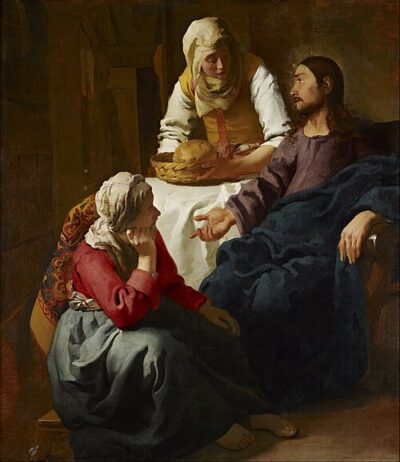
Christ in the House of Martha and Mary
Christ in the House of Martha and Mary is a painting by Johannes Vermeer, Scottish National Gallery.
- Came out
- 17th century
- Created by
- Johannes Vermeer
- Genre
- religious art
All 5 facts, and where they come from
Facts
5 facts · 0 confirmed by two sources · 4 cited · 1 from one source
Where this comes from
Papalocal keeps its own record. It started from these sources; what each one said is kept here as it was copied, so a change on their side never changes this page by itself. Tap one to read its version.
What Wikidata says · copied November 17, 2026 · revision 2569622955
- Described as
- painting by Johannes Vermeer, Scottish National Gallery
- What it is
- painting · 1 reference
- Created by
- Johannes Vermeer · 1 reference
- Genre
- religious art · 1 reference
- Came out
- 17th century · 1 reference
- Owned by
- William Allan Coats
- Wikipedias with a page
- 23
Wikidata item Q927449 (wikidata.org/wiki/Q927449), public domain (CC0). Copied 2026-11-17.
What Wikipedia says · copied November 17, 2026 · revision 1382330974
Christ in the House of Martha and Mary (Dutch: Christus in het huis van Martha en Maria) is an oil painting finished in 1655 by the Dutch Golden Age painter Johannes Vermeer. It is now in the Scottish National Gallery in Edinburgh. It is the largest painting by Vermeer (63in x 56in) and one of the very few with an overt religious subject. The story of Christ visiting the household of the two sisters Mary of Bethany and Martha goes back to the New Testament. The work has also been called Christ in the House of Mary and Martha (reversing the last two names).
From the Wikipedia article “Christ in the House of Martha and Mary (Vermeer)” (en.wikipedia.org/wiki/Christ_in_the_House_of_Martha_and_Mary_(Vermeer)), by its contributors, under CC BY-SA 4.0 (creativecommons.org/licenses/by-sa/4.0/). Copied 2026-11-17; not changed.
Confirmed Two sources agree. Cited One source, and it names where it got it. One source One source, without a reference of its own. Sources disagree The sources disagree. We show the best-supported value and keep theirs below.
Picture: Johannes Vermeer, via Wikimedia Commons · Public domain