
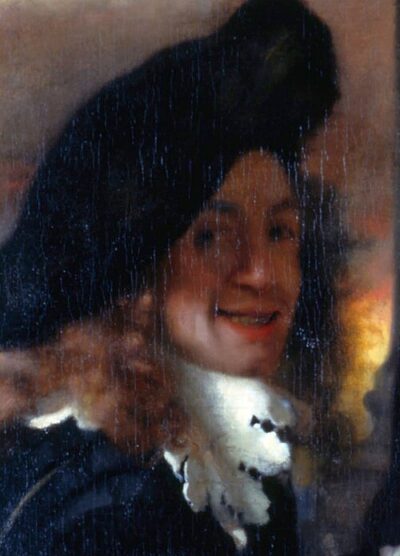
Johannes Vermeer
Johannes Vermeer was a Dutch painter. Born October 1632, in Delft. Died December 15, 1675, in Delft. Known for Diana and her Nymphs, The Geographer and The Procuress.
Facts
29 facts · 2 confirmed by two sources · 12 cited · 15 from one source
Where this comes from
Papalocal keeps its own record. It started from these sources; what each one said is kept here as it was copied, so a change on their side never changes this page by itself. Tap one to read its version.
What Wikidata says · copied November 16, 2026 · revision 2568006316
- Described as
- Dutch painter (1632–1675)
- Other names
- Vander Meer de Delft, Jan Vermeer Delft, de Delfet Vander-Meer, De Delfsche van der Meer, Vermeer van van Delft, J. Vermeer of Delft, jan van der meer der altere, Jan van Der Meer, of Delft V. der Meer, Vermeer van Delft, Ĭokhannes Vermer, Jan Vermeer de Delft
- Born
- October 1632 · 5 references
- Died
- December 15, 1675 · 1 reference
- Born in
- Delft · 4 references
- Died in
- Delft · 5 references
- Buried in
- Oude Kerk · 1 reference
- Name at birth
- Johannes Vermeer
- Citizen of
- Dutch Republic
- Occupation
- painter · 5 references; art collector · 1 reference; art dealer · 2 references
- Genre
- genre painting · 2 references; portrait · 1 reference; cityscape · 1 reference
- Known for
- Diana and her Nymphs; The Geographer; The Procuress; The Milkmaid · 1 reference; Christ in the House of Martha and Mary; The Astronomer; A Girl Asleep; Girl with a Pearl Earring; View of Delft · 1 reference
- Field
- painting · 1 reference
- Spouse
- Catharina Bolenes (1653–) · 1 reference
- Father
- Reijnier Janszoon Vermeer · 2 references
- Mother
- Digna Baltus · 2 references
- Religion
- Reformed Christianity (1632–); Catholicism (1653–)
- Lived in
- Delft
- Wikipedias with a page
- 116
Wikidata item Q41264 (wikidata.org/wiki/Q41264), public domain (CC0). Copied November 16, 2026.
What Wikipedia says · copied November 16, 2026 · revision 1383296747
Johannes Vermeer ( vər-MEER, vər-MAIR, Dutch: [joːˈɦɑnəs fərˈmeːr]; see below; also known as Jan Vermeer; October 1632 – 15 December 1675) was a Dutch painter who specialized in domestic interior scenes of middle-class life. He is considered one of the greatest painters of the Dutch Golden Age. During his lifetime, he was a moderately successful provincial genre painter, recognized in Delft and The Hague. He produced relatively few paintings, primarily earning his living as an art dealer. He was not wealthy; at his death, his wife was left in debt.
Vermeer worked slowly and with great care, and frequently used very expensive pigments. He is particularly renowned for making masterful use of light in his work. "Almost all his paintings", Hans Koningsberger wrote, "are apparently set in two smallish rooms in his house in Delft; they show the same furniture and decorations in various arrangements and they often portray the same people, mostly women."
The modest celebrity he enjoyed during his life gave way to obscurity after his death. He was barely mentioned in Arnold Houbraken's major source book on 17th-century Dutch painting (Grand Theatre of Dutch Painters and Women Artists, published 1718) and, as a result, was omitted from subsequent surveys of Dutch art for nearly two centuries. In the 19th century, Vermeer was rediscovered by Gustav Friedrich Waagen and Théophile Thoré-Bürger, who published an essay attributing 66 works to him, although only 34 paintings are universally attributed to him today. Since that time, Vermeer's reputation has grown enormously.
- Born, in its opening lines
- October 1632
- Died, in its opening lines
- December 15, 1675
From the Wikipedia article “Johannes Vermeer” (en.wikipedia.org/wiki/Johannes_Vermeer), by its contributors, under CC BY-SA 4.0 (creativecommons.org/licenses/by-sa/4.0/). Copied November 16, 2026; not changed.
Confirmed Two sources agree. Cited One source, and it names where it got it. One source One source, without a reference of its own. Sources disagree The sources disagree. We show the best-supported value and keep theirs below.
