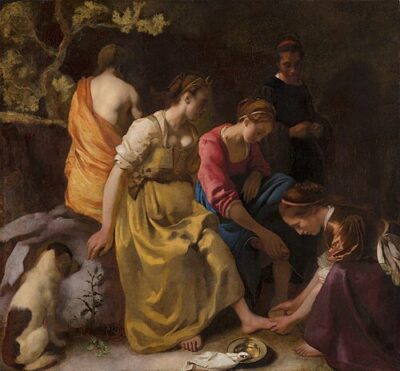
Diana and her Nymphs
Diana and her Nymphs is a painting by Johannes Vermeer.
- Came out
- 1650s
- Created by
- Johannes Vermeer
- Genre
- mythological painting
All 7 facts, and where they come from
Facts
7 facts · 0 confirmed by two sources · 5 cited · 2 from one source
Where this comes from
Papalocal keeps its own record. It started from these sources; what each one said is kept here as it was copied, so a change on their side never changes this page by itself. Tap one to read its version.
What Wikidata says · copied November 17, 2026 · revision 2569728123
- Described as
- painting by Johannes Vermeer
- What it is
- painting · 1 reference
- Created by
- Johannes Vermeer · 1 reference
- Genre
- mythological painting · 1 reference
- Came out
- 1650s · 1 reference
- Country
- Netherlands
- Owned by
- Neville Davison Goldsmid (1866–1875) · 1 reference; Mauritshuis (1876–) · 1 reference
- Wikipedias with a page
- 19
Wikidata item Q32234 (wikidata.org/wiki/Q32234), public domain (CC0). Copied 2026-11-17.
What Wikipedia says · copied November 17, 2026 · revision 1366126437
Diana and Her Companions (Dutch: Diana en haar Nimfen or Diana en haar gezellinnen) is a painting by Dutch artist Johannes Vermeer completed in the early to mid-1650s, now at the Mauritshuis museum in The Hague. Although the exact year is unknown, the work may be the artisit's earliest surviving painting, with some art historians placing it before Christ in the House of Martha and Mary and some after.
The painting's solemn mood is unusual for a scene depicting the goddess Diana, and the nymph washing the central figure's feet has captured the attention of critics and historians, both for her activity and contemporary clothing. Rather than directly illustrating one of the dramatic moments in well-known episodes from myths about Diana, the scene shows a woman and her attendants quietly at her toilette. The theme of a woman in a private, reflective moment would grow stronger in Vermeer's paintings as his career progressed.
Nothing of the work's history before the mid-19th century is known, and the painting was not widely accepted as one of Vermeer's until the early 20th century, when its similarities with Mary and Martha were noticed. About one ninth of the painting's width has been removed from the right side, and it was not discovered until 1999 or 2000 that the sky in the upper right-hand corner had been added in the 19th century.
From the Wikipedia article “Diana and Her Companions” (en.wikipedia.org/wiki/Diana_and_Her_Companions), by its contributors, under CC BY-SA 4.0 (creativecommons.org/licenses/by-sa/4.0/). Copied 2026-11-17; not changed.
Confirmed Two sources agree. Cited One source, and it names where it got it. One source One source, without a reference of its own. Sources disagree The sources disagree. We show the best-supported value and keep theirs below.
Picture: Johannes Vermeer, via Wikimedia Commons · Public domain