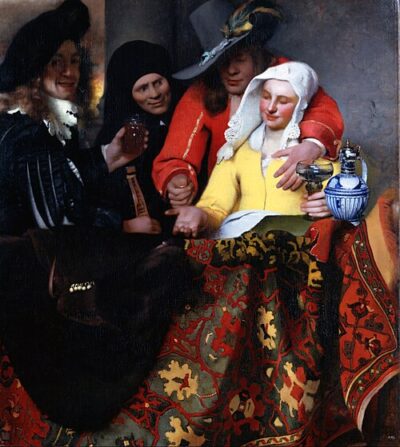
The Procuress
The Procuress is a painting by Johannes Vermeer at Gemäldegalerie Alte Meister, Dresden, Germany. It came out in 1656.
- Came out
- 1656
- Created by
- Johannes Vermeer
- Genre
- genre art
All 4 facts, and where they come from
Facts
4 facts · 0 confirmed by two sources · 3 cited · 1 from one source
Where this comes from
Papalocal keeps its own record. It started from these sources; what each one said is kept here as it was copied, so a change on their side never changes this page by itself. Tap one to read its version.
What Wikidata says · copied November 17, 2026 · revision 2569305029
- Described as
- painting by Johannes Vermeer at Gemäldegalerie Alte Meister, Dresden, Germany
- What it is
- painting · 1 reference
- Created by
- Johannes Vermeer · 1 reference
- Genre
- genre art · 1 reference
- Came out
- 1656
- Wikipedias with a page
- 24
Wikidata item Q63692 (wikidata.org/wiki/Q63692), public domain (CC0). Copied 2026-11-17.
What Wikipedia says · copied November 17, 2026 · revision 1365068161
The Procuress (Dutch: De koppelaarster) is a 1656 oil-on-canvas painting by the then 24-year-old Johannes Vermeer. It can be seen in the Gemäldegalerie Alte Meister in Dresden. It is his first genre painting and shows a scene of contemporary life, an image of mercenary love perhaps in a brothel. It differs from his earlier biblical and mythological scenes. It is one of only three paintings Vermeer signed and dated (the other two are The Astronomer and The Geographer). In 1696 the painting, being sold at an auction in Amsterdam, was named "A merry company in a room".
The woman in black, the leering coupler, "in a nun's costume", could be the eponymous procuress, while the man to her right, "wearing a black beret and a doublet with slashed sleeves", has been identified as a self-portrait of the artist; there is a resemblance with the painter in Vermeer's The Art of Painting.
It seems Vermeer was influenced by earlier works on the same subject by Gerard ter Borch, and The Procuress (c. 1622) by Dirck van Baburen, which was owned by Vermeer's mother-in-law Maria Thins and hung in her home. Some critics thought the painting is atypical of Vermeer's style and expression, because it lacks the typical light. Pieter Swillens wrote in 1950 that—if the work was by Vermeer at all—it showed the artist "seeking and groping" to find a suitable mode of expression. Eduard Trautscholdt wrote 10 years before that "The temperament of the 24-year-old Vermeer fully emerges for the first time".
The jug on the oriental rug is a piece of Westerwald Pottery. The kelim thrown over a banister, probably produced in Uşak, covers a third of the painting and shows medallions and leaves. The instrument is probably a cittern. The dark coat with five buttons was added by Vermeer in a later stage. The man in the red jacket, a soldier, is fondling the young woman's breast and dropping a coin into her outstretched hand.According to Benjamin Binstock, this "dark and gloomy" painting could be understood as a psychological portrait of his adopted family and does not represent a didactic message. Binstock says Vermeer used his family as models; the procuress could be Vermeer's wife Catherina and the lewd soldier her brother Willem.
From the Wikipedia article “The Procuress (Vermeer)” (en.wikipedia.org/wiki/The_Procuress_(Vermeer)), by its contributors, under CC BY-SA 4.0 (creativecommons.org/licenses/by-sa/4.0/). Copied 2026-11-17; not changed.
Confirmed Two sources agree. Cited One source, and it names where it got it. One source One source, without a reference of its own. Sources disagree The sources disagree. We show the best-supported value and keep theirs below.
Picture: Johannes Vermeer, via Wikimedia Commons · Public domain