Clifford algebra
Clifford algebra is an algebraic structure generated by a vector space with a quadratic form and a unital associative algebra structure.
All 2 facts, and where they come from
Facts
2 facts · 0 confirmed by two sources · 0 cited · 2 from one source
Where this comes from
Papalocal keeps its own record. It started from these sources; what each one said is kept here as it was copied, so a change on their side never changes this page by itself. Tap one to read its version.
What Wikidata says · copied November 17, 2026 · revision 2567753167
- Described as
- algebraic structure generated by a vector space with a quadratic form and a unital associative algebra structure
- Other names
- Clifford algebras
- What it is
- mathematical concept
- Named after
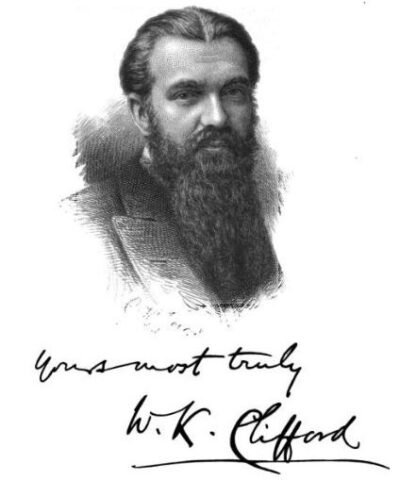
- William Kingdon Clifford
- Wikipedias with a page
- 21
Wikidata item Q674689 (wikidata.org/wiki/Q674689), public domain (CC0). Copied 2026-11-17.
What Wikipedia says · copied November 17, 2026 · revision 1385704061
In mathematics, a Clifford algebra is an algebra generated by a vector space with a quadratic form, and is a unital associative algebra with the additional structure of a distinguished subspace. As K-algebras, they generalize the real numbers, complex numbers, quaternions and several other hypercomplex number systems. The theory of Clifford algebras is intimately connected with the theory of quadratic forms and orthogonal transformations. Clifford algebras have important applications in a variety of fields including geometry, theoretical physics and digital image processing. They are named after the English mathematician William Kingdon Clifford (1845–1879).
The most familiar Clifford algebras, the orthogonal Clifford algebras, are also referred to as (pseudo-)Riemannian Clifford algebras, as distinct from symplectic Clifford algebras.
From the Wikipedia article “Clifford algebra” (en.wikipedia.org/wiki/Clifford_algebra), by its contributors, under CC BY-SA 4.0 (creativecommons.org/licenses/by-sa/4.0/). Copied 2026-11-17; not changed.
Confirmed Two sources agree. Cited One source, and it names where it got it. One source One source, without a reference of its own. Sources disagree The sources disagree. We show the best-supported value and keep theirs below.
Picture: Wikimedia Commons: Angular momentum bivector and pseudovector.svg · See Commons file page