
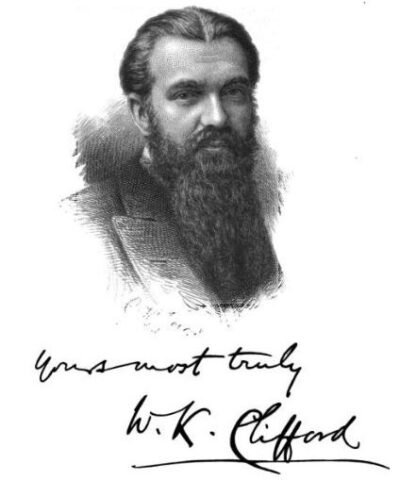
William Kingdon Clifford
William Kingdon Clifford was an English mathematician and philosopher. Born May 4, 1845, in Exeter. Died March 3, 1879, in Madeira Island. Known for Clifford algebra, Clifford's circle theorems and Clifford's theorem on special divisors. Educated at Trinity College and King's College London. Awards include Fellow of the Royal Society.
Facts
33 facts · 2 confirmed by two sources · 15 cited · 15 from one source · 1 where the sources disagree
What’s different
- Buried in: we show Highgate Cemetery (Sources disagree). Wikidata also lists Grave of William Kingdon Clifford
Where this comes from
Papalocal keeps its own record. It started from these sources; what each one said is kept here as it was copied, so a change on their side never changes this page by itself. Tap one to read its version.
What Wikidata says · copied November 16, 2026 · revision 2567506622
- Described as
- English mathematician and philosopher
- Other names
- W. K. Clifford, William Clifford
- Born
- May 4, 1845 · 9 references
- Died
- March 3, 1879 · 9 references
- Born in
- Exeter · 1 reference
- Died in
- Madeira Island · 1 reference
- Buried in
- Highgate Cemetery · 1 reference; Grave of William Kingdon Clifford
- Cause of death
- tuberculosis · 1 reference
- Citizen of
- United Kingdom of Great Britain and Ireland
- Occupation
- mathematician · 1 reference; philosopher · 1 reference; university teacher
- Worked for
- University College London (1871–1879) · 1 reference; Trinity College (1868–1871) · 1 reference
- Education
- Trinity College (1863–1867) · 1 reference; King's College London (1860–1863) · 1 reference; University of Cambridge (–1868) · 1 reference
- Member of
- Royal Society of London
- Known for
- Clifford algebra; Clifford's circle theorems; Clifford's theorem on special divisors; Clifford torus; Clifford parallel; Clifford–Klein form; Bessel–Clifford function; Elements of Dynamic; The common sense of the exact sciences; Lectures and essays
- Awards
- Fellow of the Royal Society (1874) · 1 reference
- Field
- algebra
- Spouse
- Lucy Clifford · 1 reference
- Children
- Ethel Clifford · 1 reference
- Father
- William Clifford · 1 reference
- Mother
- Frances Kingdon · 1 reference
- Religion
- atheism
- Wikipedias with a page
- 47
Wikidata item Q323228 (wikidata.org/wiki/Q323228), public domain (CC0). Copied November 16, 2026.
What Wikipedia says · copied November 16, 2026 · revision 1384546416
William Kingdon Clifford (4 May 1845 – 3 March 1879) was a British mathematician and philosopher. Building on the work of Hermann Grassmann, he introduced what is now termed geometric algebra. This is a special case of what later became known as the Clifford algebra, which was named in his honour. The operations of geometric algebra have the effect of mirroring, rotating, translating, and mapping the geometric objects that are being modelled to new positions. Clifford algebras in general and geometric algebra in particular have been of ever increasing importance to mathematical physics, geometry, and computing. Clifford was the first to suggest that gravitation might be a manifestation of an underlying geometry. In his philosophical writings he coined the expression mind-stuff.
- Born, in its opening lines
- May 4, 1845
- Died, in its opening lines
- March 3, 1879
From the Wikipedia article “William Kingdon Clifford” (en.wikipedia.org/wiki/William_Kingdon_Clifford), by its contributors, under CC BY-SA 4.0 (creativecommons.org/licenses/by-sa/4.0/). Copied November 16, 2026; not changed.
Confirmed Two sources agree. Cited One source, and it names where it got it. One source One source, without a reference of its own. Sources disagree The sources disagree. We show the best-supported value and keep theirs below.
