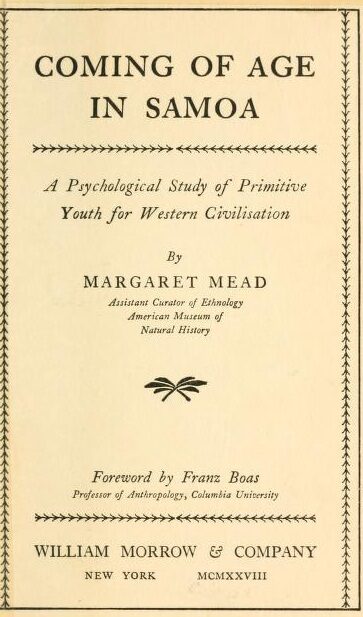
Coming of Age in Samoa
Coming of Age in Samoa is a book by Margaret Mead. It came out in 1928.
- Published
- 1928
- Written by
- Margaret Mead
- Genre
- ethnography
- Country of origin
- United States
All 7 facts, and where they come from
Facts
7 facts · 0 confirmed by two sources · 1 cited · 6 from one source
Where this comes from
Papalocal keeps its own record. It started from these sources; what each one said is kept here as it was copied, so a change on their side never changes this page by itself. Tap one to read its version.
What Wikidata says · copied November 16, 2026 · revision 2556389470
- Described as
- book by Margaret Mead
- Other names
- Coming of Age in Samoa: A Psychological Study of Primitive Youth for Western Civilization
- What it is
- literary work
- Written by
- Margaret Mead
- Publisher
- William Morrow
- Genre
- ethnography
- Published
- 1928 · 1 reference
- Language
- English
- Country of origin
- United States · 1 reference
- Wikipedias with a page
- 9
Wikidata item Q5151979 (wikidata.org/wiki/Q5151979), public domain (CC0). Copied 2026-11-16.
What Wikipedia says · copied November 16, 2026 · revision 1385175032
Coming of Age in Samoa: A Psychological Study of Primitive Youth for Western Civilisation is a 1928 book by American anthropologist Margaret Mead based upon her research and study of youth – primarily adolescent girls – on the island of Taʻū in American Samoa. The book details the sexual life of teenagers in Samoan society in the early 20th century, and theorizes that culture has a leading influence on psychosexual development.
First published in 1928, the book launched Mead as a pioneering researcher and as the most famous anthropologist in the world. Since its first publication, Coming of Age in Samoa was the most widely read book in the field of anthropology until Napoleon Chagnon's Yanomamö: The Fierce People overtook it. The book has sparked years of ongoing and intense debate and controversy on questions pertaining to society, culture, and science. It is a key text in the nature versus nurture debate, as well as in discussions on issues relating to family, adolescence, gender, social norms, and attitudes.
In the 1980s, Derek Freeman contested many of Mead's claims, and argued that she was hoaxed into counterfactually believing that Samoan culture had more relaxed sexual norms than Western culture. However, several members of the anthropology community have rejected Freeman's criticism, accusing him of cherry picking his data, and misrepresenting both Mead's research and the interviews that he conducted. Mead's field work for "Coming of Age" was also scrutinized, and major discrepancies were found between her published statements and her field data. Some Samoans are critical of what Mead wrote of their culture, especially her claim that adolescent promiscuity was socially acceptable in Samoa in the 1920s.
Coming of Age in Samoa entered the public domain in the United States in 2024.
From the Wikipedia article “Coming of Age in Samoa” (en.wikipedia.org/wiki/Coming_of_Age_in_Samoa), by its contributors, under CC BY-SA 4.0 (creativecommons.org/licenses/by-sa/4.0/). Copied 2026-11-16; not changed.
Confirmed Two sources agree. Cited One source, and it names where it got it. One source One source, without a reference of its own. Sources disagree The sources disagree. We show the best-supported value and keep theirs below.
Picture: Margaret Mead, via Wikimedia Commons · Public domain