
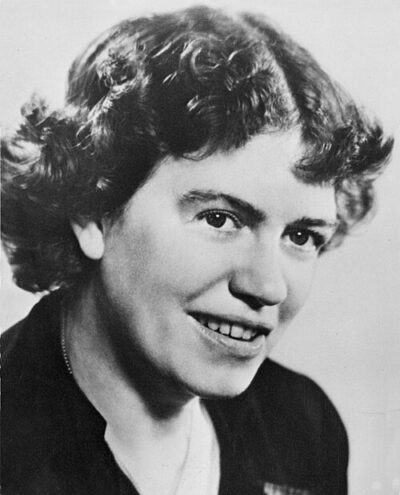
Margaret Mead
Margaret Mead was an American anthropologist. Born December 16, 1901, in Philadelphia. Died November 15, 1978, in New York City. Known for Coming of Age in Samoa. Educated at Barnard College and Columbia University. Awards include Presidential Medal of Freedom, Kalinga Prize and William Procter Prize for Scientific Achievement.
Facts
49 facts · 2 confirmed by two sources · 24 cited · 23 from one source
Where this comes from
Papalocal keeps its own record. It started from these sources; what each one said is kept here as it was copied, so a change on their side never changes this page by itself. Tap one to read its version.
What Wikidata says · copied November 13, 2026 · revision 2565533346
- Described as
- American anthropologist (1901-1978)
- Other names
- Margaret Mead Fortune, Margaret Mead Bateson, Margaret Bateson, Margaret Fortune
- Born
- December 16, 1901 · 12 references
- Died
- November 15, 1978 · 11 references
- Born in
- Philadelphia · 1 reference
- Died in
- New York City · 2 references
- Buried in
- Trinity Episcopal Church Cemetery · 1 reference
- Cause of death
- pancreatic cancer
- Citizen of
- United States
- Occupation
- anthropologist · 2 references; writer · 2 references; film director; curator; poet; ethnologist · 1 reference
- Worked for
- Columbia University; University of Rhode Island · 1 reference; American Museum of Natural History
- Education
- Barnard College; Columbia University (–1929); DePauw University; Solebury School · 1 reference
- Member of
- American Philosophical Society (1977–); American Academy of Arts and Sciences; American Academy of Arts and Letters; American Association for the Advancement of Science · 1 reference; National Academy of Sciences (1975–) · 1 reference; Graduate Women in Science; Mead & Bateson
- Known for
- Coming of Age in Samoa
- Awards
- Presidential Medal of Freedom (1979) · 1 reference; Kalinga Prize (1970) · 1 reference; William Procter Prize for Scientific Achievement (1969) · 1 reference; National Women's Hall of Fame (1976) · 1 reference; Fellow of the American Academy of Arts and Sciences; honorary doctor of the University of Miami (1978) · 1 reference; Gold Medal of the Society of Woman Geographers (1942) · 1 reference; Kurt Lewin Award (1954) · 1 reference; Elizabeth Blackwell Award (1964) · 1 reference
- Field
- cultural anthropology · 1 reference; volkerpsychologie; psychological anthropology; ethnology · 1 reference
- Spouse
- Luther Cressman (1923–1928); Reo Fortune (1928–1935) · 1 reference; Gregory Bateson (1936–1950) · 1 reference
- Children
- Mary Catherine Bateson · 1 reference
- Father
- Edward Sherwood Mead · 1 reference
- Mother
- Emily Fogg · 1 reference
- Religion
- Anglicanism
- Lived in
- Longland · 1 reference
- Wikipedias with a page
- 97
Wikidata item Q180099 (wikidata.org/wiki/Q180099), public domain (CC0). Copied November 13, 2026.
What Wikipedia says · copied November 13, 2026 · revision 1385175587
Margaret Mead (December 16, 1901 – November 15, 1978) was an American cultural anthropologist, author and speaker, who appeared frequently in the mass media during the mid-twentieth century.
Mead's first ethnographic work, Coming of Age in Samoa (1928), addressed adolescence and sexuality and catapulted her to national visibility. Her book Sex and Temperament in Three Primitive Societies (1935), explored gender roles and personality based on fieldwork in Papua New Guinea. Mead also conducted fieldwork with the Omaha people; in Manus, Papua New Guinea; and in Bali. She wrote Keep Your Powder Dry, an ethnographic examination of American life, in the hopes of supporting mobilization for World War II. She coordinated two comparative studies on modern cultures in the 1950s, while focusing her own work on Russia. Her later work included returns to Papua New Guinea, Bali, and Samoa for longitudinal studies. She was curator of ethnology at the American Museum of Natural History from 1946 to 1969. Mead served as president of the American Association for the Advancement of Science in 1975.
According to anthropologist Paul Shankman, "Mead was anthropology's most significant public voice during the twentieth century." She is regarded as a founding figure in public anthropology and visual anthropology. Her ethnography of the South Pacific and Melanesia has been subject to vigorous academic debate. From the 1920s to the 1960s, her fieldwork was widely discussed in the press and she wrote a monthly column in Redbook magazine co-authored with partner Rhoda Métraux. Her reports detailing the attitudes towards sex in South Pacific and Southeast Asian traditional cultures influenced the 1960s sexual revolution. Mead's association with cultural relativism and the sexual revolution led to sharp criticism from conservatives.
- Born, in its opening lines
- December 16, 1901
- Died, in its opening lines
- November 15, 1978
From the Wikipedia article “Margaret Mead” (en.wikipedia.org/wiki/Margaret_Mead), by its contributors, under CC BY-SA 4.0 (creativecommons.org/licenses/by-sa/4.0/). Copied November 13, 2026; not changed.
Confirmed Two sources agree. Cited One source, and it names where it got it. One source One source, without a reference of its own. Sources disagree The sources disagree. We show the best-supported value and keep theirs below.
