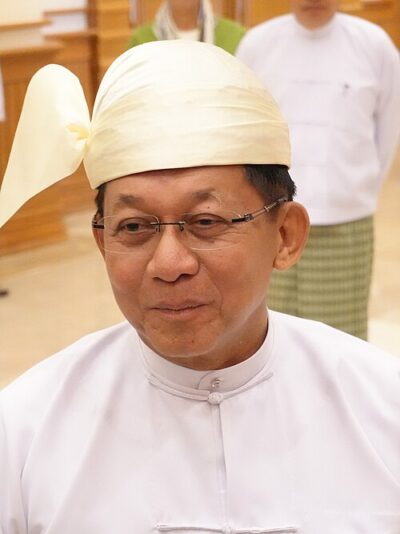
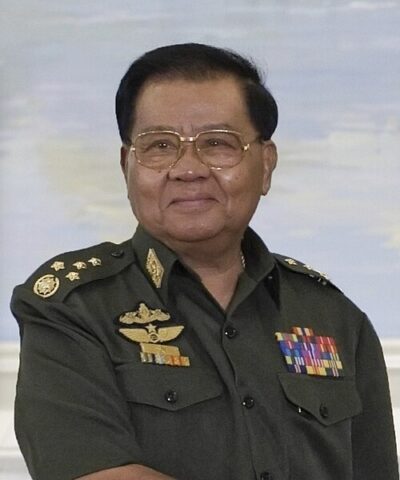
Commander-in-Chief of Defence Services
Commander-in-Chief of Defence Services is a head of the armed forces of Myanmar. It was created in 1945.
All 5 facts, and where they come from
Facts
5 facts · 0 confirmed by two sources · 0 cited · 5 from one source
Where this comes from
Papalocal keeps its own record. It started from these sources; what each one said is kept here as it was copied, so a change on their side never changes this page by itself. Tap one to read its version.
What Wikidata says · copied November 17, 2026 · revision 2553787786
- Described as
- head of the armed forces of Myanmar
- Other names
- CINCDS, Commander-in-Chief of Tatmadaw, Commander-in-Chief of the Myanmar Armed Forces
- What it is
- military position
- Created
- 1945 · 1 reference
- Country
- Myanmar
- Office of
- Myanmar
- Official website
- http://cincds.gov.mm
- Wikipedias with a page
- 6
Wikidata item Q49399317 (wikidata.org/wiki/Q49399317), public domain (CC0). Copied 2026-11-17.
What Wikipedia says · copied November 17, 2026 · revision 1379538011
The Commander-in-Chief of Defence Services (Burmese: တပ်မတော်ကာကွယ်ရေးဦးစီးချုပ်, romanized: Tatmadaw Kakweyay Uzigyoke) is the supreme commander of the Tatmadaw and all armed forces in Myanmar according to the constitution. The Tatmadaw, officially translated as "Defence Services", is an independent branch of government under control of the commander-in-chief and not answerable to the president of Myanmar, though certain actions of the commander-in-chief require the approval of the National Defence and Security Council (NDSC), which is chaired by the president. According to the 2008 Constitution of Myanmar, the commander-in-chief is appointed by the president upon nomination by the NDSC; the commander-in-chief is also a member of the NDSC.
The Constitution frames the commander-in-chief as an expressly political office, stating he "participates in the national political leadership role of the state". Accordingly, he has expansive governance powers under the Constitution, including the ability to appoint the leadership of the Home, Border, and Defence ministries, the right to appoint 25% of the members of both houses of the Pyidaungsu Hluttaw (which appoints the president), the ability to initiate impeachment proceedings against the president, as well as having effective voting control on the NDSC. One of the most significant executive powers retained by the president is discretion in calling meetings of the NDSC.
Article 418 of the 2008 Constitution allows the Commander-in-Chief broad authority over the government if the president declares a state of emergency in coordination with the NDSC. This happened after the 2021 coup d'état: military-installed acting president Myint Swe declared a state of emergency and transferred power to Commander-in-Chief, Senior General Min Aung Hlaing, who then formed a military junta—the State Administration Council.
The current Commander-in-Chief is General Ye Win Oo, since 30 March 2026.
From the Wikipedia article “Commander-in-Chief of Defence Services” (en.wikipedia.org/wiki/Commander-in-Chief_of_Defence_Services), by its contributors, under CC BY-SA 4.0 (creativecommons.org/licenses/by-sa/4.0/). Copied 2026-11-17; not changed.
Confirmed Two sources agree. Cited One source, and it names where it got it. One source One source, without a reference of its own. Sources disagree The sources disagree. We show the best-supported value and keep theirs below.